KINDERCOMICS
  • Blog
  • About
  • Contact
  • Comics@CSUN
  • Comics Studies Society
  • KIRBY!

2024 Eisner Nominees: Early Readers

5/29/2024

0 Comments

 
Picture
This post is the first in a series of three.
This year's Eisner Award nominations were announced on May 16, and my last post here was a rundown of the nominees in certain categories, especially those focused on young audiences: Early Readers, Kids, and Teens. Since then, I've been requesting books from the Los Angeles Public Library so that I can read all the nominees in those three categories before the June 6 deadline for voting.
Award competitions are inevitably biased and troublesome, I know, but as I said last year, I appreciate the heuristic value of this yearly exercise. When the Eisner noms are announced, I start gathering books like crazy! The process keeps me in the swim of things (as a former Eisner judge, I like to stay involved). I note that last year LAPL was able to supply me with most of the nominees, and the same has been true this year; young readers' graphic books appear to be well represented in my public library. 
This post, the first of three, focuses on the Early Readers nominations, which I have finished reading as of today. I've tried to describe each nominee fairly, while spotlighting my favorites. Posts on the Kids and Teens categories will follow soon. 
Picture
​Bigfoot and Nessie: The Art of Getting Noticed, by Chelsea M. Campbell and Laura Knetzger (Penguin Workshop)
Two cryptids – Bigfoot, who cannot get noticed by the world, and Nessie, who would rather not be – form a mutually affirming friendship. Together, they make art when no one is looking, bonding over spontaneous creative risk-taking. Yet their friendship is tested when Bigfoot achieves the fame he hungers for. This is one of those cartooned books that looks simple on the surface but is restlessly designed and dense. Knetzger’s bright, candy-colored pages are elaborate and multilayered, sometimes perhaps to the point of confusion; a spread of the two friends drawing chalk art is a wonder. A fragile conceit, lovingly rendered.
Picture
​Burt the Beetle Lives Here! by Ashley Spires (Kids Can Press)
Burt, a June beetle, thinks it might be best to get out from under his leaf and find a more permanent home. It turns out that what works for carpenter ants, tent caterpillars, wasps, or cathedral termites doesn’t work for him. As Burt bounces from one slapstick moment to another, trying out different things, the bland, omniscient narration keeps informing him (and us) about what he and other critters need. Crisp digital cartooning and subtly varied layouts (most pages have fewer than four panels) serve both the humor and the science lesson. Format-wise, this reminds me of a TOON book.
Picture
​Go-Go Guys, by Rowboat Watkins (Chronicle Books)
Thumping iambs and breathless running text lend a lockstep rhythm, but also surprises, to a rollicking picture book about revved-up “guys” who cannot go to sleep (but end up going to the moon). The art is at once wild and decorous: full of energy, yet within safe, neat bounds. Watkins’ drawings (seemingly pencil and watercolor, but perhaps also digital?) have the delicacy of Arnold Lobel, but then again, his screwball humor recalls James Marshall. The book is perhaps not as anarchic as it wants to be, but I dig the sudden lunges and dynamic layouts. A great read-aloud, I bet.
Picture
​The Light Inside, by Dan Misdea (Penguin Workshop)
This pint-sized book (5.75 x 5.75 inches, 32 pages) tells a gentle, wordless story about a child with a jack-o’-lantern head who travels through a spooky landscape to recover his stuffed animal, taken by a black cat. Creepy things turn out to be benign, and adversaries turn out to be helpers. The story has an almost beatific calm despite the Gothic trappings. Misdea, a New Yorker cartoonist, prioritizes design and simplicity (his uncle, Patrick McDonnell of Mutts fame, has been an inspiration). The book’s small pages somehow make room for between three and seven panels each, with perfect clarity. Charming.
Picture
Milk and Mocha: Our Little Happiness, by Melani Sie (Andrews McMeel)
Collected strips about two bears and their pet dino, from the heavily merchandised social media phenom MilkMochaBear. These characters began as stickers for the LINE app – emoji, basically – and have since spread. The comics strike me as ideal for Instagram: short, spare, and cute, in the kawaii sense, with a whiff of Sanrio. But are they for early readers? They read as humorous valentines for adult couples: bite-sized comic affirmations of love and domesticity. Often, they involve social media (the bears are continually on their phones). The humor depends on routine and slight nuances. I confess, this nomination puzzles me.
Picture
Tacos Today: El Toro & Friends, by Raúl the Third, colors by Elaine Bay (Versify)
My emphatic pick in this category, this vibrant, positively Kirbyesque explosion of energy boasts super-cool characters and restive page design. A diverse cast of anthropomorphic critter-kids from “Ricky Ratón’s School of Lucha” gets mucha hambre and goes out for tacos, though they don’t have the dinero to pay. A demonstration of their lucha skills saves the day. Raúl the Third draws up a storm here, with a punky, inky roughness that translates beautifully into digitally finished pages (OMG, Bay’s colors!). Mingled Spanish and English text, and myriad background cues, make this a multicultural bonanza inviting read-aloud interaction and conversation. Fantastic.

Some final thoughts: This category feels more adventurous this year than it did last year. My emphatic faves are The Light Inside and especially Tacos Today, but most of the books are interesting, and several of them are visually daring. I continue to be interested in the way this category makes room for picture books, which is an important, underacknowledged format for children’s comics. That's encouraging.
BTW, I did not know any of these books before the Eisner nominations were announced. I found all of them save one (Milk and Mocha) through LAPL. ​
0 Comments

Eisner Award Nominations 2024

5/17/2024

2 Comments

 
The nominations for this year's Will Eisner Comic Industry Awards (celebrating work published in 2023) were just announced yesterday. ​Of course I'm already looking up and bookmarking things I want to read, with a big thank you to judges Ryan Claytor, Chris Couch, Andréa Gilroy, Joseph Illidge, Mathias Lewis, and Jillian Rudes!

I always learn from, and of course debate, the Eisner nominations. Unsurprisingly, there are always some choices that leave me bewildered and omissions that make me sad. But I know what this job is like from the inside out (having served as an Eisner judge in 2013). It's not easy. Yes, it's delightful work, but it's heavy, and it's not casual. It takes a lot of negotiation. Props to the judges for making the tough calls and shining spotlights on so many deserving works.

Below are the nominees in the three categories of special interest to KinderComics, that is, those focused on young readers: Early Readers, Kids, and Teens. I've also noted two other categories of special interest to me that I think are particularly strong this year, Best Graphic Memoir and Best Academic/Scholarly Work. Where possible, I've linked the title of each work to a publisher's webpage, FYI. 

In the weeks ahead, and especially prior to the June 6 voting deadline, I hope to read and comment on many of the nominees in Early Readers, Kids, and Teens categories. Thus far, I've read only a few. I have requests out at my local branch of LAPL for as many of these books as I can get! I've found that bingeing on the Eisner noms each year is a great learning experience!

Best Publication for Early Readers
​I'm ashamed to say that I haven't read any of these yet!
​​
  • Bigfoot and Nessie: The Art of Getting Noticed, by Chelsea M. Campbell and Laura Knetzger (Penguin Workshop/Penguin Random House)
  • Burt the Beetle Lives Here! by Ashley Spires (Kids Can Press)
  • Go-Go Guys, by Rowboat Watkins (Chronicle Books)
  • The Light Inside, by Dan Misdea (Penguin Workshop/Penguin Random House)
  • Milk and Mocha: Our Little Happiness, by Melani Sie (Andrews McMeel)
  • Tacos Today: El Toro & Friends, by Raúl the Third (HarperCollins/Versify)

Best Publication for Kids

  • Buzzing, by Samuel Sattin and Rye Hickman (Little, Brown Ink)
  • Mabuhay! by Zachary Sterling (Scholastic Graphix)
  • Mexikid: A Graphic Memoir, by Pedro Martín (Dial Books for Young Readers/Penguin Young Readers). I've read this one and will be teaching it in Children's Lit this fall. It's excellent.
  • Missing You, by Phellip Willian and Melissa Garabeli. translation by Fabio Ramos (Oni Press)
  • Saving Sunshine, by Saadia Faruqi and Shazleen Khan (First Second/Macmillan)

Best Publication for Teens

  • Blackward, by Lawrence Lindell (Drawn & Quarterly). I've read this one, which is by an artist that I think I've seen at LA Zine Fest (and at a CSUN event as well). Good to see his book here!
  • Danger and Other Unknown Risks, by Ryan North and Erica Henderson (Penguin Workshop/Penguin Random House). I've read this one, and it made my Best of 2023 list over at The Comics Journal.
  • Frontera, by Julio Anta and Jacoby Salcedo (HarperAlley)
  • Lights, by Brenna Thummler (Oni Press)
  • Monstrous: A Transracial Adoption Story, by Sarah Myer (First Second/Macmillan)
  • My Girlfriend’s Child, Vol. 1, by Mamoru Aoi, translation by Hana Allen (Seven Seas)

Best Graphic Memoir
This is the category I'm most prepared for this year, having read four out of the six noms so far. I'm interested to see that several of these could also be nominated in young readers' categories.
​
  • Family Style: Memories of an American from Vietnam, by Thien Pham (First Second/Macmillan). A wonderful book, again part of my Best of 2023 list. I reviewed it here on June 28, 2023.
  • A First Time for Everything, by Dan Santat (First Second/Macmillan)
  • In Limbo, by Deb JJ Lee (First Second/Macmillan). Another great one that I reviewed here, back on June 27, 2023. It also made my Best of 2023.
  • Memento Mori, by Tiitu Takalo, translation by Maria Schroderus (Oni Press). I haven't read this one yet.
  • Sunshine: How One Camp Taught Me About Life, Death, and Hope, by Jarrett J. Krosoczka (Scholastic Graphix). Nor have I read this one.
  • The Talk, by Darrin Bell (Henry Holt). And yet another that made my Best of 2023.

Best Academic/Scholarly Work
A fantastic group this year! Innovative and important work all round.
​
  • Asian Political Cartoons, by John A. Lent (University Press of Mississippi)
  • The Claremont Run: Subverting Gender in the X- Men, by J. Andrew Deman (University of Texas Press)
  • Desegregating Comics: Debating Blackness in the Golden Age of American Comics, edited by Qiana Whitted (Rutgers University Press)
  • If Shehrazad Drew: Critical Writings on Arab Comics, by George Khoury-Jad (Sawaf Center for Arab Comics Studies and American University of Beirut Press)
  • In Visible Archives: Queer and Feminist Visual Culture in the 1980s, by Margaret Galvan (University of Minnesota Press)
  • Super Bodies: Comic Book Illustration, Artistic Styles, and Narrative Impact, by Jeffrey A. Brown (University of Texas Press)
I won't begin to make predictions about which books and creators will win. Suffice to say that my reading for the next few weeks will be interesting!

PS. Among the Eisner noms I've read lately that didn't make my Best of 2023 list, but I wish had, are Mexikid; A First Time for Everything; Bill Griffith's Three Rocks: The Story of Ernie Bushmiller; K. Wroten's Eden II; Tillie Walden's Clementine, Book Two; ​and Kelly Sue DeConnick et al.'s Wonder Woman Historia: The Amazons.

PPS. Among things I dearly wish had made the Eisner ballot? Noah Van Sciver's Maple Terrace; Wes Craig's Kaya; Ryan Holmberg's translation of Tsuge's Nejishiki; Ryan North et al.'s Fantastic Four; Craig Thompson's Ginseng Roots; Tom King and Elsa Charretier's continuing Love Everlasting; Tom Kaczynski's Cartoon Dialectics #4; 
Joe Kessler's The Gull Yettin; Seth's Palookaville #24; Chantal Montellier's Social Fiction; and Daniel Clowes's Monica. Insert a big Schulzian SIGH here for all of these. <3
2 Comments

Little Monarchs (OMG)

6/13/2023

0 Comments

 
Picture
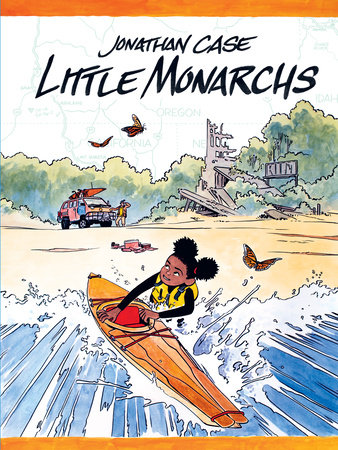
Little Monarchs. By Jonathan Case. Holiday House/Margaret Ferguson Books , ISBN 9780823442607 , 2022. US$22.99. 256 pages. A Junior Library Guild Gold Standard Selection.
This post comes belatedly and is not much more than a mash note. A few days ago, I called the Eisner Award-nominated Little Monarchs, by Jonathan Case, "an extraordinary piece of worldmaking, ... dense, involving, subtle, and beautiful." I stand by that. It is one of the best graphic books for readers of any age I've read in a while (and I've been reading a lot of good ones lately, now that school is out).
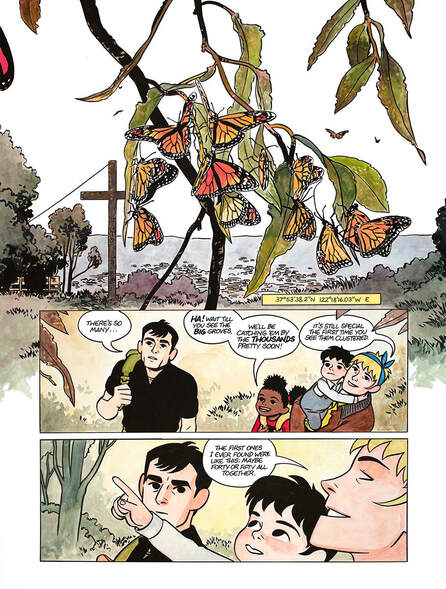
I dove into Little Monarchs hurriedly, without doing my usual obsessive reading of paratexts, indicia, and so on (I'm usually a bit compulsive about how I crack open books that are new to me). I had the book out from my local branch of LAPL and was bingeing before casting my annual Eisner votes, so I was rushing. I hadn't even read the jacket copy. So, it wasn't until I finished the first of the book's dozen chapters that I began to realize that the story was set in a world I did not quite recognize, or a changed version of our world where something had gone wrong (I overlooked a detail given on the first page: that the date is 2101). In fact, Little Monarchs is a post-apocalyptic survival story, though officially a middle-grade (ages 8-12) sort of book. In it, a ten-year-old girl, Elvie, and her guardian, a forty-something biologist named Flora, drive through a drastically depopulated North America in which most people dwell underground, unable to travel safely in sunlight. Elvie and Flora mostly avoid encounters with these "deepers," preferring to go it alone. They dread attacks by "marauders," that is, scavengers who would pirate their stuff.
Picture
So, the world of Little Monarchs is different. In it, about fifty years have passed since a "sun shift" has killed off most mammal life. Prolonged exposure to direct sunlight (more than a few minutes) can be fatal. Most human survivors are socked away in underground bunkers, and only a few crepuscular or nocturnal mammals, such as bats, can hope to survive. Flora and Elvie are able to live topside because Flora has developed a medicine that keeps them safe from "sun sickness" for up to about a day and a half at a time. The medicine derives from the milkweed within monarch butterflies, so Flora and Elvie follow the yearly path of the monarchs' migration, catching butterflies, harvesting scales from their wings, releasing them, and creating ever more batches of meds. At the same time, Flora seeks a more permanent solution in the form of a heritable vaccine. Little Monarchs, then, is the story of an never-ending road trip and a scientific quest.

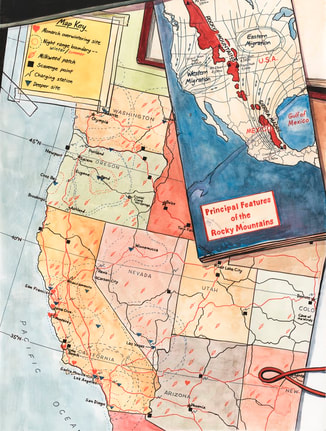
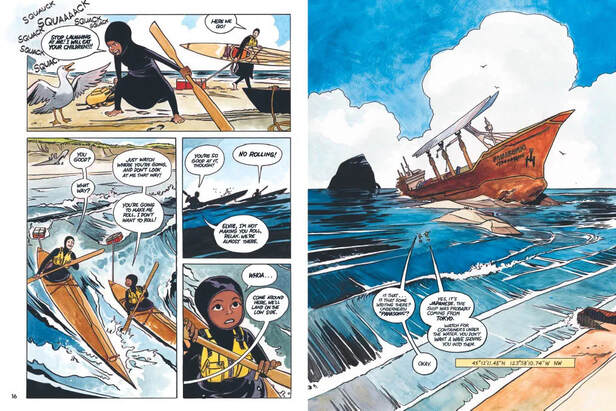
Remarkably, this survival story reads less like horror and more like an adventure. That has everything to do with the character of Elvie, a Black girl who is resourceful, eagle-eyed, courageous, decent, and funny. Elvie explores and improvises and above all uses her head. She can face down her fears and make do when disaster strikes. The heart of Little Monsters is the bond between Elvie and Flora, her White caregiver, who is something like a mom, big sister, tutor, and friend all at once, and whose quirks Elvie knows and forgives. You can believe that these two understand and love each other. The book gains heft from Elvie's journal entries: expository interludes that serve to orient the reader while showing off her smarts. These entries combine Elvie's home-school assignments (given by Flora), drawings, reflections, and tips. Elvie knows how to live in the wild world Jonathan Case has imagined, and her entries impart a great deal of knowledge. Case has mapped her story onto real locations, using real geographic coordinates, and included a wealth of fascinating detail about everything from knot tying to the monarchs' life cycle. The story-world fits this girl to a tee, and vice versa. 
Picture
Little Monarchs takes interesting risks. As a survivalist story in a broken world, it delves into the hard ethical questions that such scenarios tend to pose: What are you willing to do to survive? Do the ethical constraints of civil society apply when the world has been upended? Must you be willing to hurt others to protect yourself? The story kicks into gear when Elvie finds another, much younger child wandering in the sunlight and has to take him in, which leads to Elvie and Flora nervously weighing the risks of involvement with other people. At first, Flora seems somewhat mistrustful, even phobic, about taking that risk, but, as things turn out, she has good reason to be. There are reversals, betrayals, and shocks in the story. The last act depicts hard things — and Elvie has to do some hard things, too. Little Monarchs isn't The Road, of course (RIP to the brilliant Cormac McCarthy), but does ask its readers to weigh questions of ethics and risk in the face of grave danger. Somehow it does this and remains a thrilling adventure and credible middle-grade story about a plucky ten-year-old kid. 
Picture
And the visual artistry of it! Little Monarchs is a feast of lovely images made by hand, from the lettering to the gorgeous watercolors. Reading it against a backdrop of other recent graphic novels for young readers, even good ones, I was reminded of how seldom I get to see work at this scale that is handcrafted even down to its finest details. Case is a terrific comics artist, designing dynamic pages, drawing believable characters and environments, pacing and punctuating riveting sequences of high-stakes action as well as quiet scenes of discovery, and making every detail count. As I said a few days ago, he cartoons with an economy and grace that recall Alex Toth as well as latter-day classicists who have drunk from the same well: Jaime Hernandez, R. Kikuo Johnson, and Chris Samnee. His character designs, breakdowns, staging, and layouts are equal to his terrific writing. 
Little Monarchs urges engagement with the natural world and offers readers all sorts of potential adventures off the page as well as on. You could take this book on the road with you and learn a lot. More than anything, it is a classic quest story, pulled off with warmth, wit, and bravery, surprising and gutsy right up to its very last page. After reading so many well-intended moral and political fables for children in which messages are reliably delivered and conclusions are just what one would expect, I took delight in its splendid eccentricity. Highest recommendation!​
0 Comments

Last-Minute Thoughts about the 2023 Eisners

6/9/2023

0 Comments

 
I like to keep up with the Eisner Awards. I'm a former judge, I value recognitions of excellence in the comics world (even when they're contentious), and I like staying in touch with the process. Honestly, it can be hard to find and read every single nominee, but each year I pay particular attention to, and try to spend time with, all the nominees in the young readers' categories. Currently, that means three categories: Early Readers, Kids (ages 9-12), and Teens. Over the past week, I've read about ten books to get up to speed! 
I'm told that today, June 9, is the last day to cast votes (officially, the vote is "open until June 10, 2023 12:01 AM (GMT-05:00) Eastern Time"). So, this evening I'm going to vote in as many categories as I feel qualified to vote in!
This year's Eisner process has been especially vexed and controversial (leading to a retroactive withdrawal from the ballot). The ballot has been a bit mystifying to me, with some, IMO, startling omissions and puzzling categorizations. But controversy is in the nature of the awards, and I still appreciate the heuristic value of this, let's say, yearly exercise. Here are my thoughts on the Early Reader, Kids, and Teens categories:
Picture
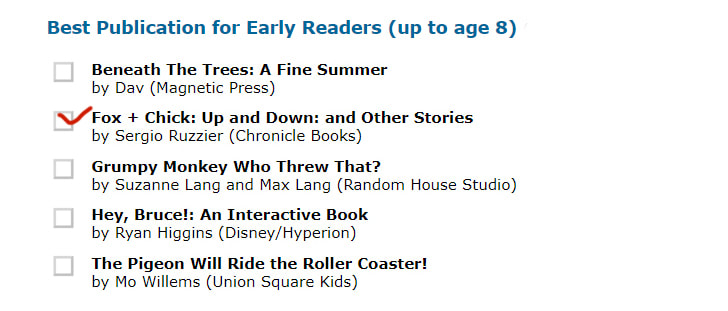
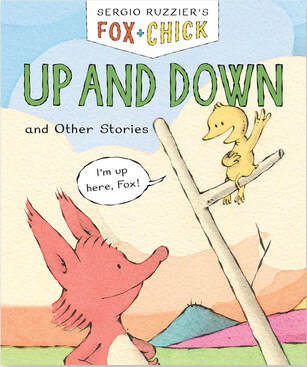
Early Readers: I admit, this is not a category that interests me much this year. There are some lovely images here (for sheer sumptuousness, Dav's Disneyesque watercolors are hard to beat), and some nice comic bits (the page-turns of Higgins, the pacing of Willems), but for the most part these books strike me as pat and aesthetically undaring. There's a lot of shtick here, which tires me out. I miss seeing some good TOON Books in this category; 2022 seems to have been fallow for them. That said, my choice here is this charming, quietly ironic, aesthetically delicate take on friendship and learning:
Picture
Picture

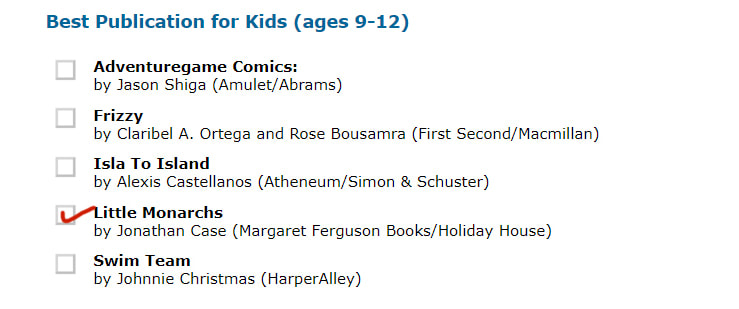
​Kids (9-12): This is a more interesting category by far, in fact one of the deepest in this year's ballot. The craft on display is impressive (dig the cartooning in Frizzy and Swim Team), and the ambition (dig the near-wordless storytelling of Isla to Island, a complex tale of immigration, loss, and discovery; or the interactive, formally ingenious Adventuregame). But my hands-down choice is Little Monarchs, an extraordinary piece of worldmaking, which is cartooned with an Alex Toth-like economy that reminds me of elegant classicists like Jaime Hernandez, R. Kikuo Johnson, and Chris Samnee. An amazing book, so dense, involving, subtle, and beautiful:
Picture
Picture
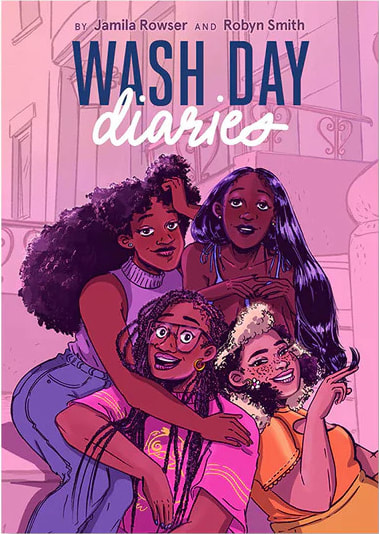
​Teens: It's nice to see Tillie Walden in this category, for a book that is a change of pace for her. But I think the outstanding title here is the already much-talked about, groundbreaking Wash Day Diaries, a suite of stories about four Black women and the strength of their friendship and interconnection. Every character in this book has a backstory, but Rowser and Smith smartly leave us guessing, focusing on the energy, grace, and good humor of the four. Darkness marks the edges of the story, but joy wins out. The book seems casual, the way eavesdropping on good friends can, but that's deceptive; there's a lot going on. The chapter devoted to their "group chat" is a wonder of form as well as characterization. I admit that I didn't see this as a YA book at first, but then, I usually have that reaction to books that turn out to be very good YA books!
Picture
A few observations:
  • Some of the nominees in these categories strike me as utopian. Then again, some of them, even some of the very same ones, try to tackle very serious, socially and psychologically fraught themes from within the conventions of young readers' books. Frizzy, for example, deals with internalized racism and anti-Blackness among Latinos, while Swim Team deals with white racism as an obstacle to Black swimming culture. These books are affirming, and tie up all their loose ends neatly. They also show the bravery of children healing the hearts of wounded adults. I don't know whether to chafe at their determined positivity, which I worry leads to pat conclusions, or admire their gutsiness for essaying such themes in the first place!
  • I've read three books in the past week that explore the politics of beauty, and contest racist beauty standards, through loving, detailed depictions of Black girls and women doing their hair. Frizzy makes this its very subject, while Swim Team addresses the issue briefly. Wash Day Diaries contains long, joyous, sensuous sequences of hair care. This reminds me: I've got to reread Ebony Flowers' Hot Comb soon!
  • The tension between "comic book" and "picture book" will likely continue to be felt in the Early Readers category. I'm not sure that that's a firm distinction (I and colleagues of mine have worried this bone before), but I did notice myself making the distinction when running through the category. The page-turning in Higgins' Hey, Bruce! really put me in mind of this.
I look forward to casting my votes, tonight. But before 9pm Pacific!
​
0 Comments

2021 Eisner Awards Update

8/13/2021

0 Comments

 
The 2021 Eisner Awards were announced in a virtual ceremony or video released on Friday, July 23, part of Comic-Con@Home. The ceremony, hosted (once again) by actor Phil LaMarr, runs just over an hour and can be viewed via YouTube on the Comic-Con International channel:

https://youtu.be/RuVslpoC2nI


This year's was a solid and fairly satisfying Eisner Awards crop, and mostly unsurprising, given the ballot announced on June 9. Out of the thirty-two award categories, I was mildly surprised by five or six. Going into the ceremony, I had strong feelings about just three or four categories. In almost all cases, my daughter Nami was able to call the winner just before LaMarr announced it!

These past few weeks, I’ve been checking out a number of Eisner nominees and winners from my local library, the LAPL. Good reading!
Picture
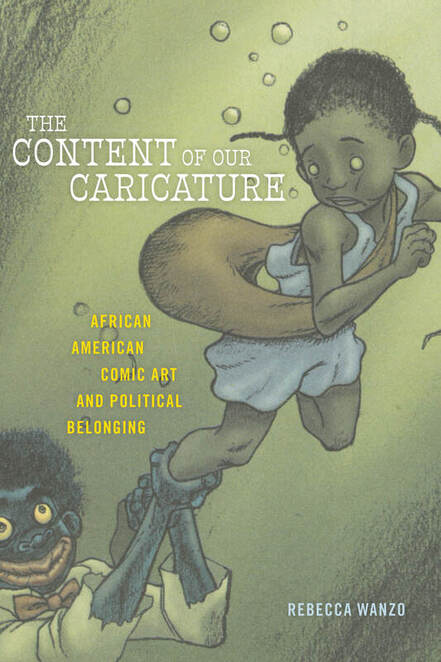
I congratulate all of this year's winners, and, again, particularly congratulate the nominees in the Academic/Scholarly Work category. Readers, do seek out all the books in that category, especially the Award-winner, Rebecca Wanzo's The Content of Our Caricature, which is innovative and important! As I've said before, when that book came to my mailbox, I stood transfixed and read a whole chapter before even sitting down. The book is brave, startling, and bracing: a must. My congratulations to Dr. Wanzo on this well deserved (further) recognition!
PS. I hope I will be able to write up some of my recent reading here at KinderComics. This is a time of bereavement and struggle for my family, so my writing and reading time is sorely limited, but I do hope to reconnect, here, in this space I've tended for so long. Peace, everybody.
0 Comments

2021 Eisner Award notes

6/15/2021

0 Comments

 
Picture
​The nominees for the 2021 Will Eisner Comics Industry Awards – the most prestigious set of awards given within the US comic book and graphic novel industries – were announced on June 9. This year’s judging panel consisted of comics retailer Marco Davanzo, Comic-Con International board member Shelley Fruchey, librarian Pamela Jackson (San Diego State University), creator/publisher Keithan Jones, educator Alonso Nuñez, and comics historian Jim Thompson. As usual, the ballot recognizes an eclectic mix of material, with awards in thirty-two categories, including the following three young-reader categories:

Best Publication for Early Readers (up to age 8)
  • Bear, by Ben Queen and Joe Todd-Stanton (Archaia/BOOM!)
  • Cat Kid Comic Club, by Dav Pilkey (Scholastic Graphix)
  • Donut Feed the Squirrels, by Mika Song (RH Graphic/RH Children’s Books)
  • Kodi, by Jared Cullum (Top Shelf)
  • Lift, by Minh Lê and Dan Santat (Little, Brown Young Readers)
  • Our Little Kitchen, by Jillian Tamaki (Abrams Books for Young Readers)
Best Publication for Kids (ages 9-12)
  • Doodleville, by Chad Sell (Knopf/BFYR/RH Children’s Books)
  • Go with the Flow, by Lily Williams and Karen Schneemann (First Second/Macmillan)
  • Mister Invincible: Local Hero, by Pascal Jousselin (Magnetic Press)
  • Snapdragon, by Kat Leyh (First Second/Macmillan)
  • Superman Smashes the Klan, by Gene Luen Yang and Gurihiru (DC), reviewed here on 7/21/2020
  • Twins, by Varian Johnson and Shannon Wright (Scholastic Graphix)
Best Publication for Teens (ages 13-17)
  • Check, Please! Book 2: Sticks & Scones, by Ngozi Ukazu (First Second/Macmillan)
  • Displacement, by Kiku Hughes (First Second/Macmillan)
  • Dragon Hoops, by Gene Luen Yang (First Second/Macmillan), reviewed here 3/25/2020 
  • Fights: One Boy’s Triumph Over Violence, by Joel Christian Gill (Oni Press)
  • A Map to the Sun, by Sloane Leong (First Second/Macmillan)
  • When Stars are Scattered, by Victoria Jamieson and Omar Mohamed (Dial Books)
Wow, what a list!
This year’s ballot looks smart and interesting to me. As always, I could gripe about oversights, omissions, and puzzling choices. Of course! I’ve been an Eisner judge myself (2013), so I know that the job is challenging, even overwhelming. I get it. The Eisners represent several different communities (after all, they are not a guild prize like the Oscars or the Grammys) and it’s not easy for the yearly ballot to satisfy everyone. That said, I am learning a lot by looking up this year’s nominees.  
In addition to the nominees in the dedicated young-reader categories above, there are nominations in many other categories that may interest followers of children’s and young adult comics. What follows is not an exhaustive list, but just a few items that I noticed:
Best Single Issue: 
  • Stanley’s Ghost: A Halloween Adventure, by Jeff Balke, Paul Storrie, and Dave Alvarez (Storm Kids)
Best Continuing Series
  • Usagi Yojimbo, by Stan Sakai (IDW)
Best Reality-Based Work
  • Dragon Hoops, by Gene Luen Yang
Best Graphic Memoir
  • Banned Book Club, by Kim Hyun Sook, Ryan Estrada, and Ko Hyung-Ju (Iron Circus)
  • When Stars Are Scattered, by Victoria Jamieson and Omar Mohamed
Best Graphic Album—Reprint
  • Herobear and the Kid: The Heritage, by Mike Kunkel (Astonish Factory)
Best Adaptation from Another Medium
  • Superman Smashes the Klan, by Gene Luen Yang and Gurihiru​
Best U.S. Edition of International Material
  • Gamayun Tales I: An Anthology of Modern Russian Folk Tales, by Alexander Utkin, translated by Lada Morozova (Nobrow)
  • Irena Books 2-3, by Jean-David Morvan, Severine Tréfouël, and David Evrard, translated by Dan Christensen (Magnetic Press)
  • When You Look Up, by Decur, translated by Chloe Garcia Roberts (Enchanted Lion Books)
Best Archival Collection/Project—Comic Books
  • Little Lulu: The Fuzzythingus Poopi, by John Stanley et al., edited by Frank Young and Tom Devlin (Drawn & Quarterly), reviewed here 1/18/2021
Best Writer/Artist
  • Pascal Jousselin, Mister Invincible: Local Hero (Magnetic Press)
  • Trung Le Nguyen, The Magic Fish (RH Graphic/RH Children’s Books)
  • Gene Luen Yang, Dragon Hoops
Best Penciller/Inker or Penciller/Inker Team
  • Bertrand Gatignol, Pistouvi (Magnetic Press)
Best Painter/Multimedia Artist (interior art)
  • Jared Cullum, Kodi
  • Decur, When You Look Up
Readers, I urge you to seek out all of these works!
Picture
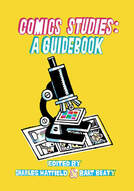
On a personal note, I'm honored that the book I co-edited with Bart Beaty, Comics Studies: A Guidebook (Rutgers University Press), has been nominated for an Eisner in the category Best Academic/Scholarly Work. This is a testimony to the superb work of our co-contributors: Jan Baetens, Isaac Cates, Mel Gibson, Ian Gordon, Martha Kuhlman, Frenchy Lunning, Brian MacAuley, Matt McAllister, Andrei Molotiu, Philip Nel, Roger Sabin, Kalervo Sinervo, Marc Singer, Theresa Tensuan, Shannon Tien, Darren Wershler, Gillian Whitlock, and Benjamin Woo.

​Our Guidebook is in excellent company. The other nominees for Best Academic/Scholarly Work are:

  • Comic Art in Museums, edited by Kim A. Munson (University Press of Mississippi), a groundbreaking volume that I feel lucky to be part of
  • The Content of Our Caricature: African American Comic Art and Political Belonging, by Rebecca Wanzo (New York UP), a stunning book, and winner of the 2021 Kovács Book Award given by the Society for Cinema and Media Studies
  • Webcomics, by Sean Kleefeld (Bloomsbury), a terrific resource that I have reviewed recently and look forward to using in my teaching ASAP
  • Who Understands Comics: Questioning the Universality of Visual Language Comprehension, by Neil Cohn (Bloomsbury), a vital contribution to the research on comics literacy

More than one of these books has fundamentally changed the way I look at my field. Again, readers, I urge you to check out these thought-provoking works. Also, check out the work in the other comics scholarship category, that of Best Comics-Related Book:
  • American Daredevil: Comics, Communism, and the Battles of Lev Gleason, by Brett Dakin (Comic House/Lev Gleason)
  • Ditko Shrugged: The Uncompromising Life of the Artist Behind Spider-Man and the Rise of Marvel Comics, by David Currie (Hermes Press)
  • Drawing Fire: The Editorial Cartoons of Bill Mauldin, edited by Todd DePastino (Pritzker Military Museum & Library)
  • The History of EC Comics, by Grant Geissman (TASCHEN)
  • Invisible Men: The Trailblazing Black Artists of Comic Books, by Ken Quattro (Yoe Books/IDW)
  • Masters of British Comic Art, by David Roach (2000AD)
There is so much to learn here!
0 Comments

2020 Eisner Award Nominees

6/18/2020

0 Comments

 
Update, June 29, 2020: Due to a technical or information-security problem, the Eisner Award voting has been restarted from scratch on a new online platform, and the new deadline for votes extended until tomorrow, Tuesday, June 30, at 11:59pm Pacific. Reportedly, voters who previously cast a ballot have been sent emails inviting them to vote again. I'm voting again at this very moment!
Voting for this year’s Will Eisner Comic Industry Awards (the Eisners for short) will soon end, so file this post under "belated." Sigh. Unfortunately, the current COVID-19 lockdown and related stresses have slowed me down, so this comes late.
Picture
But: onward. This year’s list of Eisner nominees (announced on June 4) is another extraordinary snapshot of a (as ever) divided field that encompasses multiple, sometimes divergent, communities, a field that often feels like many fields at once. Having been an Eisner judge (2013), I can attest to what a joy and challenge it is to access, read, and debate so many different kinds of comics with other judges assembled from several different disciplines. If the final results of the Eisner voting are often an index of popularity, or simply of the kinds of comics that get noticed readily in shops, the ballot is less predictable and more expansive, reflecting the painstaking efforts of longtime Eisner Award Administrator Jackie Estrada and the diverse, carefully-selected judging panels she recruits. Those panels are typically balanced to include comics creators, retailers, journalists, critics, and scholars, and, once recruited, are fully autonomous and, in my experience, absolutely honest about what they like and don’t. It’s a great, once-in-a-lifetime gig.

In my case, I spent a long weekend in a San Diego hotel conferring with my fellow judges. This year’s panel, however, has had to judge remotely, connecting via social media and Zoom (I can’t imagine). The process reportedly took two months longer than usual. But the panel sounds like it was an amazing group: journalist and scholar Jamie Coville; graphic novel reviewer Martha Cornog; my friend, scholar/teacher/designer Michael Dooley; comics writer and novelist Alex Grecian; podcaster and Comic-Con volunteer Simon Jimenez; and retailer and festival organizer Laura O’Meara. Michael has some telling comments and reflections on this year’s process, and his own values and priorities as a judge, in a PRINT magazine interviewer with Steven Heller that came out last week (worth a look). I agree with Michael that the list of nominees is the important thing, “the news that  readers can most usefully use”; like him, I didn’t particularly care about who won the final voting, but loved taking part in the crafting of the ballot. This year’s list is an excellent and illuminating guide to this particular moment in comics.
As I said, the comics community often feels like several disparate communities: different, even conflicting, publics and aesthetic formations. The Eisners, unlike guild awards such as the Oscars or Tonys, are voted on by a wide, dispersed group not held together by membership in a professional body, and the judging and voting processes reflect that. Jackie Estrada has deliberately set out to recruit diverse judges that can represent some of the many publics that make up the comics field and yet can also dialogue across boundaries and bring some focus to the awards. The continuing excellence of the yearly ballots bears out the wisdom of her efforts – congratulations, once again, to the judges and Jackie for a job well done!
Of particular interest to KinderComics are the nominees in the young readers’ categories, and this year they’re terrific:

​Best Publication for Early Readers

  • Comics: Easy as ABC, by Ivan Brunetti (TOON), which I’ve already used as a textbook
  • Kitten Construction Company: A Bridge Too Fur, by John Patrick Green (First Second/Macmillan)
  • The Pigeon HAS to Go to School! by Mo Willems (Hyperion Books)
  • A Trip to the Top of the Volcano with Mouse, by Frank Viva (TOON)
  • ¡Vamos! Let's Go to the Market, by Raúl the Third (Versify/Houghton Mifflin Harcourt)

Best Publication for Kids

  • Akissi: More Tales of Mischief, by Marguerite Abouet and Mathieu Sapin (Flying Eye/Nobrow)
  • Dog Man: For Whom the Ball Rolls, by Dav Pilkey (Scholastic Graphix)
  • Guts, by Raina Telgemeier (Scholastic Graphix)
  • New Kid, by Jerry Craft (Quill Tree/HarperCollins)
  • This Was Our Pact, by Ryan Andrews (First Second/Macmillan)
  • The Wolf in Underpants, by Wilfrid Lupano, Mayana Itoïz, and Paul Cauuet (Graphic Universe/Lerner Publishing Group)
(I confess to some disappointment here. Where is Luke Pearson's Hilda and the Mountain King? Where's Jen Wang's superb Stargazing?)

Best Publication for Teens

  • Harley Quinn: Breaking Glass, by Mariko Tamaki and Steve Pugh (DC)
  • Hot Comb, by Ebony Flowers (Drawn & Quarterly)
  • Kiss Number 8, by Colleen AF Venable and Ellen T. Crenshaw (First Second/Macmillan)
  • Laura Dean Keeps Breaking Up with Me, by Mariko Tamaki and Rosemary Valero-O'Connell (First Second/Macmillan)
  • Penny Nichols, by MK Reed, Greg Means, and Matt Wiegle (Top Shelf)
I also want to note that Lois Lowry’s classic dystopia for young readers, The Giver, has been adapted by P. Craig Russell into a graphic novel nominated in the category Best Adaptation from Another Medium. In addition, children’s and YA comics creators were nominated in several other categories:
  • Mariko Tamaki (Laura Dean Keeps Breaking Up with Me; Harley Quinn: Breaking Glass; Archie) for Best Writer
  • Raina Telgemeier (Guts) and Tillie Walden (Are You Listening?) for Best Writer-Artist
  • Rosemary Valero-O'Connell (Laura Dean Keeps Breaking Up with Me) for Best Penciller/Inker
  • Léa Mazé (Elma, A Bear’s Life, Vol. 1) for Best Painter/Digital Artist
  • Lorena Alvarez (Hicotea) and Molly Mendoze (Skip) for Best Coloring
  • Jim Campbell (Lumberjanes: The Shape of Friendship; At the End of Your Tether; etc.), Stan Sakai (Usagi Yojimbo), and Tillie Walden (Are You Listening?) for Best Lettering
A few more observations:
All told, there are some 180 Eisner nominees this year, spread over thirty-one categories (again, the full list is here). This year’s judges have moved even farther afield that usual, testifying to the increasing impact of not only children’s and YA comics but also digital comics, native webcomics, and other sectors beyond the traditional comic book shop. The ballot strays off the usual beaten paths and is an education in itself. While there are a number of categories in which I do not have a strong opinion (teaching through the pandemic has curtailed my comics reading these past few months), I’m greatly impressed by the lists for Best Short Story, Best Webcomic, Best Archival Collection/Project—Strips, Best Graphic Album—New, and the three journalistic and scholarly categories: Best Comics-Related Periodical/Journalism, Best Comics-Related Book, and Best Academic/Scholarly Work.
In fact, I just have to list the nominees in the following three categories, which are incredible:

Best Academic/Scholarly Work

(This is a great year for comics studies titles. Dig the diversity of topics and publishers!)
  • The Art of Pere Joan: Space, Landscape, and Comics Form, by Benjamin Fraser (University of Texas Press)
  • The Comics of Rutu Modan: War, Love, and Secrets, by Kevin Haworth (University Press of Mississippi)
  • EC Comics: Race, Shock, and Social Protest, by Qiana Whitted (Rutgers University Press)
  • The Peanuts Papers: Writers and Cartoonists on Charlie Brown, Snoopy & the Gang, and the Meaning of Life, edited by Andrew Blauner (Library of America)
  • Producing Mass Entertainment: The Serial Life of the Yellow Kid, by Christina Meyer (Ohio State University Press) - I'm proud to co-edit, with Jared Gardner, the OSUP's Studies in Comics and Cartoons series, which published this volume!
  • Women’s Manga in Asia and Beyond: Uniting Different Cultures and Identities, edited by Fusami Ogi et al. (Palgrave Macmillan)

Best Webcomic

(As soon as the ballot came out, I went and read or re-read all the nominees, Wow!)
  • Cabramatta, by Matt Huynh, http://believermag.com/cabramatta/
  • Chuckwagon at the End of the World, by Erik Lundy, https://hollowlegcomics.tumblr.com/chuckwagon 
  • The Eyes, by Javi de Castro, https://www.javidecastro.com/theeyes
  • Fried Rice Comic, by Erica Eng, https://friedricecomic.tumblr.com
  •  reMIND, by Jason Brubaker, https://is.gd/T7rafM
  • Third Shift Society, by Meredith Moriarty, https://www.webtoons.com/en/supernatural/third-shift-society/list?title_no=1703

Best Short Story

(Again, a rich, revelatory list!)
  • “Hot Comb,” by Ebony Flowers, in Hot Comb (Drawn & Quarterly)
  • “How to Draw a Horse,” by Emma Hunsinger, The New Yorker, https://www.newyorker.com/humor/daily-shouts/how-to-draw-a-horse
  • “The Menopause,” by Mira Jacob, The Believer, https://believermag.com/the-menopause/
  • “Who Gets Called an ‘Unfit’ Mother?” by Miriam Libicki, The Nib, https://thenib.com/who-gets-called-an-unfit-mother/
  • “You’re Not Going to Believe What I’m About to Tell You,” by Matthew Inman, The Oatmeal, https://theoatmeal.com/comics/believe
Finally, I commend the judges for inducting artists Nell Brinkley and E. Simms Campbell into the Eisner Hall of Fame, and for nominating fourteen others, out of which four will be inducted by the voters: Alison Bechdel, Howard Cruse, Moto Hagio, Don Heck, Jeffrey Catherine Jones, Francoise Mouly, Keiji Nakazawa, Thomas Nast, Lily Renée Peter Phillips, Stan Sakai, Louise Simonson, Don and Maggie Thompson, James Warren, and Bill Watterson. (That’s a hard list to choose from!)
A final note: The Eisner winners were to be have been announced at the usual gala ceremony on Friday night (July 24) during the San Diego Comic-Con; now, however, they will be announced online instead, sometime in July I hear, most likely as part of Comic-Con@Home. Details TBA. 
0 Comments

Too Long in Exile

7/29/2019

0 Comments

 
Picture
KinderComics, alas, has been away for too long. This spring and summer, I have had to channel my energies elsewhere. I hate to admit it, but my academic-year workload does not make room for frequent blogging, and when the summer or intersession comes around, well, then I end up having to advance or complete other long-simmering projects. Lately I’ve had to cut back, refocus, and make a point of not driving myself nuts! Still, I am going to push for several reviews this summer; I want to keep KinderComics alive. The field of children’s comics is too important, and my interest in it too intense, to let go.
I’ll have a review of 5 Worlds: The Red Maze up later this week, and then a few (probably short) ones between now and Labor Day, in order to keep the engine humming. Thank you, readers, for checking out or revisiting KinderComics. I’ll keep pushing.
There has been a great deal of news on the children's comics front during my four-month absence. Would that I could go into all these stories in detail:
  • HarperCollins Children’s Books has announced HarperAlley, a new graphic novel imprint to be directed by Andrew Arnold, former art director and editor at First Second (Publishers Weekly's Calvin Reid has the story here). Arnold envisions a bold publishing program that will put out "about 10 books a season, or about 30 books a year." Wow.
  • Random House Graphic, a new comics imprint heralded back in May 2018 and headed by Gina Gagliano (also a veteran of First Second), recently announced (just in time for Comic-Con International) its debut list, i.e. its first set of releases, due starting in January 2020. (Newsarama has the press release here, and you can find out about the first four titles at RH Graphic's new website, here.)
  • DC has cancelled its middle-grade imprint, DC Zoom, and young adult imprint, DC Ink, only months after publishing the first books in those lines (and after announcing many forthcoming titles: see articles here and here). Announced to great fanfare in February 2018, the two imprints seemed to signal a commitment to original graphic novels for young readers, and showed early signs of commercial success, yet have fallen prey to a corporate reorganization (which also includes the closing of Vertigo, DC's historic imprint for older readers and creator-owned titles). From here on out, DC titles for middle-grade readers will be published with the age rating label "DC Kids" (ouch), while DC titles for young adults will simply be labeled "DC." (Heidi MacDonald has the story, at The Beat, here.) Don't get me started on DC.
  • University Press of Mississippi has announced the pending publication of With Great Power Comes Great Pedagogy: Teaching, Learning, and Comics, a scholarly essay collection edited by Susan Kirtley, Antero Garcia, and Peter Carlson. This interdisciplinary volume promises to do something unusual in the professional literature: bridge the gap between K-12 and higher-education perspectives. Look for it in February 2020.
Besides all that news, awards have been given out:
  • The Excellence in Graphic Literature Awards announced their 2019 winners at the Denver Pop Culture Con on June 1. They include Tiger vs. Nightmare by Emily Tetri, The Eye that Never Sleeps by Marissa Moss and Jeremy Holmes, Crush by Svetlana Chmakova, The Faithful Spy by John Hendrix, Illegal by Eoin Colfer and Andrew Donkin, Hey, Kiddo by Jarrett Krosoczka, Monk! by Youssef Daoudi, and Berlin by Jason Lutes. The Book of Year went to Berlin, while the diversity-themed Mosaic Award went to the first book ever reviewed on this blog, The Prince and the Dressmaker by Jen Wang. Full details can be found in the Pop Culture Classroom's press release, here.
  • Winners of the 2019 Will Eisner Comic Industry Awards were announced at Comic-Con International on July 19. Best Publication for Early Readers (up to age 8) went to Johnny Boo and the Ice Cream Computer, by James Kochalka; Best Publication for Kids (ages 9–12) went to The Nameless City: The Divided Earth, by Faith Erin Hicks; Best Publication for Teens (ages 13–17) went to The Prince and the Dressmaker, by Jen Wang, who also won the award for Best Writer/Artist. Other award-winners that may particularly interest advocates of children's and YA comics include Giant Days, by John Allison, Max Sarin, and Julia Madrigal, for Best Continuing Series and Best Humor Publication; Brazen: Rebel Ladies Who Rocked the World, by Pénélope Bagieu, for Best U.S. Edition of International Material; and Umami, by Ken Niimura, for Best Digital Comic. It was a bang-up night for First Second, which won in five categories. See the full official list of winners here.
  • Tillie Walden's superb On a Sunbeam won the Los Angeles Times Book Prize for Graphic Novel/Comics, awarded on April 12 on the eve of the LA Times Festival of Books. See the official Prize announcements, including other nominees, here.
My gosh, what a busy and exciting field. Keeping up is a challenge! I hope to do a better job going forward.

A sad postscript

When it comes to public-facing scholarship and comics criticism, one of the most inspiring figures to my mind was the late Derek Parker Royal, co-creator, producer, and editor of The Comics Alternative podcast. Derek, a major critic of Philip Roth, Jewish American literature and culture, and graphic narrative, passed away recently, leaving a grievous sense of loss in the hearts of many. He was a scholar, innovator, and facilitator of a rare kind, generous, engaged, and prolific, and will be greatly missed in the comics studies community. He brought many people into that community; for example, at the Comics Studies Society conference in Toronto last weekend, his longtime collaborator Andy Kunka spoke movingly of how Derek encouraged him to enter the field. I will think of Derek whenever I post here, and the soaring example that he set.

Picture

RIP Derek. Thank you for your scholarship, your advocacy, and your spirit.
0 Comments

Comic-Con 2018: What's on the Program?

7/16/2018

0 Comments

 
Picture

San Diego's mammoth Comic-Con International is happening this coming week, July 18-22, once again filling the city's Convention Center, harborfront, Gaslamp Quarter, and myriad hotels with thousands and tens of thousands of pop culture fans and purveyors. I, though a CCI veteran, will be sitting out Comic-Con this year, for financial and personal reasons, but, as usual, I have been skimming the Con program with interest. It's my way of staying in touch. Studying the CCI program reminds me of the delights and frustrations of the Comic-Con experience, the sheer scale of the thing, and the uneasy overlapping of fan communities that make CCI such a beast. 

I've learned to look out for specific things in the program and focus on them ruthlessly, while filtering out literally hundreds of other things. The personalized online scheduling provided by SCHED.org, with its color-coding and organization by day, venue, and category, makes filtering that much easier. This year I have a particular eye for the following:
  • The third annual Comic Conference for Educators and Librarians (CCEL), that is, the slate of librarian and educator-focused sessions that will once again be happening during the run of CCI but offsite, at San Diego's Central Library, specifically its Shiley Special Events Suite. The CCEL has become a great new tradition. It begins on Wednesday evening (Preview Night) and continues through Sunday. I gather that it can serve as a professional development event for librarians and teachers. CCEL is actually a free public event, i.e. you do not need a Comic-Con badge to attend, but space is limited, so attendees must either register in advance for each day or have valid Comic-Con badges (CCI badge-holders are not required to register).
  • The academic sessions that comprise the Comic Arts Conference, one of the longest-lived annual academic gatherings in comics studies. These will be happening in the Convention Center's Room 26AB.
  • The sessions put on by the nonprofit Comic Book Legal Defense Fund, featuring CBLDF executive director Charles Brownstein, editorial director Betsy Gomez, and others. These will mostly be in the Convention Center's Room 11.
  • The 30th annual Will Eisner Comic Industry Awards, which will be given out, per tradition, in a lavish ceremony on Friday night at the Hilton Bayfront. (I wrote about this year's slate of nominees back in April.)
  • Sessions featuring certain of Comic-Con's special guests: Thi Bui, Emil Ferris, Liniers, Jason Lutes, Carol Tyler, Noah Van Sciver, Tillie Walden, Jen Wang, and my CSU Northridge colleague, Randy Reynaldo. (Plus, wow, Raina Telgemeier and Molly Ostertag are each doing a bunch of panels.)
This year I note an especially strong emphasis on progressive political issues, including questions of diversity and inclusion, representation, social justice, geek activism, the challenges of bullying and incivility, and the pitfalls of cultural appropriation. I also see, as expected, a continuing emphasis on children's and YA publishing, which have become crucial parts of Comic-Con. 
What follows is a list of particular panels I'd be trying to get to if I were at Comic-Con, aside from the obvious spotlights on individual artists (Bui, Ferris, Liniers, Walden, Wang, Reynaldo) and graphic novel publishers that I admire (e.g. Abrams, Drawn & Quarterly). Clicking on the panels' titles will take you to online descriptions:

Teaching with Comics: An Interactive Workshop for Educators
Wednesday, July 18, 4:00-6:00pm, San Diego Central Library, Shiley Suite

This workshop opens the CCEL, and seems to be becoming an annual tradition. It's a great way for educators to kick off their San Diego experience. This involves dear colleagues of mine, speaking on important things and facilitating hands-on activities, and would be an unmissable Must for me were I able to attend CCI. Per the program:
Peter Carlson (Green Dot Public Schools), Susan Kirtley (Portland State University), and Antero Garcia (Stanford University) lead this hands-on workshop for integrating comic books in your classrooms. Using contexts from K-12 to higher education instruction and communities of comic scholars, this action-packed workshop guides participants through approaches to teaching comics and teaching with comics while including the voices of Nhora Lucia Serrano (MIT Press), Johnathan Flowers (Southern Illinois University), and Ben Bolling (University of North Carolina) to share key strategies, theories, and scholarship on comics pedagogy.

Writing and Drawing the Past
Thursday, July 19, 10:00-11:00am, Convention Center Room 32AB

Featuring Thi Bui, Jason Lutes, Noah Van Sciver, and Jen Wang, and moderated by Abraham Riesman.

Art During the Holocaust
Thursday, July 19, 1:30-2:30pm, Convention Center Room 4

An examination of WW2-era art and propaganda, including the perspectives of Holocaust survivor Ruth Goldschmiedova Sax and her daughter, author Sandra Scheller.

The Treasury of British Comics: Can a Forgotten Archive Teach Us about Comics in the 21st Century?
Thursday, July 19, 2:00-3:00pm, Convention Center Room 29AB

A panel on Britain's tradition of weekly comic papers, described here as a "missing link between American comics, European comics, and manga."

YA Comics FTW!
Thursday, July 19, 3:30-4:30pm, Convention Center Room 4

Featuring Jen Wang, Scott Westerfeld, and Tillie Walden.

Splashing Ink on Museum Walls
Thursday, July 19 , 4:00-5:00pm, Convention Center Room 29AB

A topic of particular interest to me, given my curatorial experience, plus a strong lineup, a sharp moderator, and a peek into the coming Comic-Con Center for Popular Culture. Per the program:
Do comics belong in museums? Lots of major art and cultural institutions seem to think so, with ambitious new shows and comic art museums springing up everywhere, including one spearheaded by Comic-Con itself. Artist/writer Emil Ferris (My Favorite Thing Is Monsters), Kim Munson (editor, From Comics to Frames: Comic Art in Museums), writer/editor and exhibition consultant Ann Nocenti, and SDCC museum director Adam Smith converse about the future of comics on display, moderated by Rob Salkowitz (Forbes, Full Bleed).
[Having recently met with Adam Smith to discuss the SDCC museum, I'm excited about where this conversation could go.]

Superstars in Children's Graphic Novels
Thursday, July 19, 5:30-6:30pm, Convention Center Room 26AB

Featuring Raina Telgemeier, Jarrett Krosoczka, Aron Steinke, Molly Ostertag, Ian Boothby, and Gale Galligan.

Transformation Magic: Transgender Life in Comics from Street Level to the Stratosphere
Thursday, July 19, 6:00-7:00pm, Convention Center Room 28DE

This strikes me as a great breakthrough: "What do comics both indie and mainstream have in store for the transgender community in a politically fraught climate? How can trans comics artists best serve their creative and financial interests in an industry that has yet to fully embrace them?" Tied into Prism Comics and the trans comic anthology We're Still Here.

How to Read Nancy (with Paul Karasik and Mark Newgarden)
Thursday, July 19, 7:00-8:00pm, Convention Center Room 28DE

A work of obsessive genius and a very useful textbook!

Meet the Makers: Kids' Comics Extravaganza
Friday, July 20, 11:00am-12:00pm, San Diego Central Library, Shiley Suite

Aron Steinke, Jennifer Holm, Jordan Crane, and Heidi Arnhold talk process!

Revolutionary Ink: The 50th Anniversary of Underground Comix
Friday, July 20, 1:30-2:30pm, Convention Center Room 8

Featuring Mary Fleener, Denis Kitchen, Trina Robbins, Ron Turner, Carol Tyler, Robert Williams, and moderator Charles Brownstein.

Trends in Graphic Novel Publishing
Friday, July 20, 2:00-3:00pm, San Diego Central Library, Shiley Suite

Peggy Burns (Drawn & Quarterly), Margot Wood (Oni Press), Emily Meehan (Disney Publishing Worldwide), and, I think, Gina Gagliano (Random House Graphic) in conversation. Sponsored by the Children's Book Council Graphic Novel Committee.

LGBTQ Graphic Novels
Friday, July 20, 4:00-5:00pm, San Diego Central Library, Shiley Suite

Aminder Dhaliwal, Molly Ostertag, and Ivy Noelle Weir.

Using Graphic Novels to Cope with Bullying
Saturday, July 21, 10:00-11:00am, San Diego Central Library, Shiley Suite

With Dr. Katie Monnin (Pop Culture Classroom), Raina Telgemeier, Molly Ostertag, Christina "Steenz" Stewart (Archival Quality), teacher Derek Heid , and moderator Tom Racine. 

My First Comic
Saturday, July 21, 12:00-1:00pm, Convention Center Room 29AB

Jen Wang, Matt Loux, Jim Pascoe, and Mairghread Scott “discuss the first comics they read and the journey from reading their first comic to making their first comic.” 

The Comics Revolution (with First Second's Mark Siegel)
Saturday, July 21, 1:00-2:00pm, Convention Center Room 29AB

Adapting Folklore, History, and Myth in Comics
Saturday, July 21, 2:00-3:00pm, San Diego Central Library, Shiley Suite

Johnnie Christmas, Marco Finnegan, John Jennings, Kit Seaton, and moderator Katie Monnin. 

Wimmen's Comix
Saturday, July 21, 3:30-4:30pm, Convention Center Room 26AB

Per the program: In the early 1970s, a group of women proved to the world that underground comix—and mainstream comics—wasn't just a boy's club by publishing the first and longest-running all-women comics anthology, Wimmen's Comix. Trina Robbins, Mary Fleener, Lee Marrs, and Carol Tyler discuss of how they made herstory addressing menstruation, reproductive rights, and countless other topics that their male counterparts were unwilling or unable to tackle. Moderated by Betsy Gomez (CBLDF Presents She Changed Comics).

Alternative Comics Anthologies, Then and Now
Saturday, July 21, 4:30-5:30pm, Convention Center Room 26AB

Great topic, great lineup: Eric Reynolds, Justin Hall, Carol Tyler, Robert Goodin, Manuele Fior, and moderator Rob Salkowitz.

Audrey Niffenegger and Eddie Campbell on Their Bizarre Romance
Sunday, July 22, 10:00-11:00am, Convention Center Room 29AB

The Annual Kirby Tribute, moderated by Mark Evanier
Sunday, July 22, 10:00-11:15am, Convention Center Room 5AB

Of course a tradition for me!

Comics Studies at Michigan State University
​Sunday, July 22, 1:00-2:00pm, San Diego Central Library, Shiley Suite

Ryan Claytor (a friend and colleague of mine) shares information about MSU's expanding comics studies curriculum, including its Comics Studies minor.

Cultivating a Comic Book Culture in Academic Librarianship
Sunday, July 22, 2:00-3:00pm, San Diego Central Library, Shiley Suite

Glad to see my colleague Allison Mandaville on this panel! Per the program: Raymond Pun (librarian), Allison Mandaville (professor of English), Michelle Pratt (library specialist), and Jenny Banh (professor of anthropology) discuss strategies and practices for academic libraries to collaborate with teaching faculty to create a comic book culture in the classroom and in universities today.

Comics Arts Conference #16:
The Culture of Comic-Con: Field Studies of Fans and Marketing
Sunday, July 22, 2:30-3:30pm, Convention Center Room 26AB

Nine student researchers "present initial findings from a week-long ethnographic field study of the intersection of fan practice at the nexus of cultural marketing and fan culture that is Comic-Con 2018." Field experience organized and panel moderated by my colleague, Matthew J. Smith, Director of the School of Communications at Radford University.

Friends, colleagues, readers, whatever your interests, if you're going to Comic-Con I hope you have a rich, productive, exciting experience! Years ago, Tom Spurgeon, at The Comics Reporter, offered a guide to surviving and enjoying CCI, and I think it's still worth a look. If you do go, treat yourself well, and gently, stay watered, take breaks, and set aside some time for friends. It's a huge stampede of an event, but a bit of down time can work wonders.
0 Comments

2018 Eisner Award Nominees

4/26/2018

0 Comments

 
The nominees for the 2018 Will Eisner Comic Industry Awards were announced today, and they make for a fascinating ballot!
Picture
​The Eisners are the leading awards in the comic book and graphic novel industry. Established thirty years ago and given out each summer at San Diego's Comic-Con International, they've been organized by CCI's Jackie Estrada since 1991. The awards are voted on by industry professionals (this year's voting deadline is June 15). This year's winners will be announced in an awards ceremony at CCI on Friday, July 20.

This year's nominees were selected, as usual, by a judging panel representing various sectors and stakeholders in the comics business. The panel included Young Adult librarian and former YALSA President 
Candice Mack, journalist and podcaster Graeme McMillan, comics and pop culture retailer Tate Ottati, writer and comic book creator Alex Simmons, longtime Comic-Con and Cartoon/Fantasy Organization organizer William F. Wilson, and my esteemed colleague, scholar-teacher Nhora Lucía Serrano (with whom I've worked in the Comics Studies Society).

To me, the news of the Eisner nominations tends to be more exciting than the award results, because the ballot is such a cross-section of comics culture and always contains surprises. Every Eisner ballot documents a complex process of negotiation and compromise. I know how complex it can be, because in 2013 I served as a judge (along with Michael Cavna, Adam Healy, Katie Monnin, Frank Santoro, and John Smith). It's an experience I will not forget. Judging the Eisners entails reading many, many comics in a short time, then coming together with colleagues--smart, dedicated folks with diverse perspectives and interests--and working across differences to fashion a ballot that gathers up the various strands of long-form comics and represents a fair sample of outstanding work. The judges' final summit (typically a long weekend in April), at least as I experienced it, is about hours and hours of last-minute reading, and then, just as importantly, hours and hours spent around a table hashing out the ballot. Intense, exhausting, and delightful. I remember reading late into the night; I remember chatting and arguing; I remember a room that smelled like paper. Hats off for this year's judges--librarian, journalist, retailer, creator, organizer, and scholar--for their hard work, and for crafting a ballot that reflects exciting changes in the comics field. 
Of particular interest to KinderComics are the young readers' categories:
BEST PUBLICATION FOR EARLY READERS (UP TO AGE 8):
  • Adele in Sand Land, by Claude Ponti, translated by Skeeter Grant (!) and Françoise Mouly (TOON)
  • Arthur and the Golden Rope, by Joe Todd-Stanton (Flying Eye/Nobrow)
  • Egg, by Kevin Henkes (Greenwillow Books)
  • Good Night, Planet, by Liniers (TOON)
  • Little Tails in the Savannah, by Frederic Brrémaud and Federico Bertolucci, translated by Mike Kennedy (Lion Forge/CubHouse)
BEST PUBLICATION FOR KIDS (AGES 9–12):
  • Bolivar, by Sean Rubin (Archaia)
  • Home Time (Book One): Under the River, by Campbell Whyte (Top Shelf)
  • Nightlights, by Lorena Alvarez (Nobrow)
  • The Tea Dragon Society, by Katie O’Neill (Oni)
  • Wallace the Brave, by Will Henry (Andrews McMeel)​
BEST PUBLICATION FOR TEENS (AGES 13-17):
  • The Dam Keeper, by Robert Kondo and Dice Tsutsumi (First Second/Tonko House)
  • Jane, by Aline Brosh McKenna and Ramón K. Pérez (Archaia)
  • Louis Undercover, by Fanny Britt and Isabelle Arsenault, translated by Christelle Morelli and Susan Ouriou (Groundwood Books/House of Anansi)
  • Monstress, by Marjorie Liu and Sana Takeda (Image)
  • Spinning, by Tillie Walden (First Second)
These categories have become quite competitive, reflecting the surge in young readers' comics and the influence of children's and YA librarians, who have generally championed the graphic novel format. Notably, these are categories in which the final Eisner voting does not predictably follow popularity in the direct market (i.e. comic shops) but instead seems to reflect the interests of other communities. There have been strong winners in these categories over the past few years, and this year's nominees are a strong, exciting, varied group. Again, kudos to the judges for selecting such a wide-ranging, unconventional set!
Beyond the above categories, there are children's and YA comics-related nominees in others, such as Best Academic/Scholarly Work (Picturing Childhood: Youth in Transnational Comics, edited by Heimermann and Tullis); Best Comics-Related Book (How to Read Nancy: The Elements of Comics in Three Easy Panels, by Karasik and Newgarden); Best Digital Comic (Quince, by Kadlecik, Steinkellner, and Steinkellner); and Best Short Story (“Forgotten Princess,” by Johnson and Sandoval, Adventure Time Comics #13). Also, some of the above creators are nominated in individual categories: Lorena Alvarez for Best Writer/Artist, Isabelle Arsenault for Best Penciller/Inker, Ramón K. Perez for Best Penciller/Inker, and Federico Bertolucci for Best Painter/Multimedia Artist. In fact, this year may mark a new high point in individual nominations for creators of young readers' comics. The ballot gives me an exciting sense of children's and YA comics as emphatically mainstream and recognized for their artistry and daring as well as their accessibility.
It's such a strong ballot overall, with many startling inclusions. Beyond children's and YA comics, check out "A Life in Comics: The Graphic Adventures of Karen Green" (Best Short Story), or Pope Hats #5 (Best Single Issue), or the startling range of the whole Best Anthology category. Check out (wow) Small Favors in Best Graphic Album--Reprint, or Kindred in Best Adaptation from Another Medium. Or My Brother’s Husband in Best U.S. Edition of International Material—Asia. Among reprints, check out the two gorgeous Sunday Press books (Best Archival Collection/Project—Strips) and Conundrum's Collected Neil the Horse (Best Archival Collection/Project—Comic Books). There are many gutsy choices in this year's list—congratulations, judges, and happy reading, everybody!
0 Comments
Forward>>

    Author

    See Hatfield, comics and children's culture scholar

    Archives

    May 2026
    March 2026
    January 2026
    October 2025
    June 2025
    May 2025
    January 2025
    December 2024
    July 2024
    June 2024
    May 2024
    March 2024
    June 2023
    February 2023
    December 2022
    July 2022
    April 2022
    January 2022
    December 2021
    September 2021
    August 2021
    June 2021
    May 2021
    January 2021
    December 2020
    November 2020
    October 2020
    August 2020
    July 2020
    June 2020
    March 2020
    February 2020
    January 2020
    December 2019
    November 2019
    October 2019
    August 2019
    July 2019
    March 2019
    December 2018
    November 2018
    October 2018
    July 2018
    June 2018
    May 2018
    April 2018
    March 2018
    February 2018

    Categories

    All
    392
    About KinderComics
    Abrams
    Adaptations
    ALA
    Animal Stories
    Anthologies
    Anti Sexism
    Anti-sexism
    Awards
    Best American Comics
    Biography
    Bookshops
    BOOM! Studios
    Business
    CALA
    CalRBS
    CBLDF
    CCEL
    Children's Lit In Academia
    Class/Classism
    Collaborations
    Comic Con International
    Comic-Con International
    Comics As Social Protest
    Comic Shops
    Comics In Academia
    Comics Studies Society
    Comic Strips
    Courses
    COVID-19 Lockdown
    DC Comics
    Decade In Review
    Dial Books
    Didacticism
    Disability
    Disney/Hyperion
    Drawn & Quarterly
    Early Readers
    Ecology
    EGL Awards
    Eisner Awards
    Essential Graphic Novels
    Ethics
    Eulogies
    Events
    Exhibitions
    Fairy Tales
    Fantagraphics
    Fantasy
    Faves
    First Second Books
    Flying Eye Books
    Folklore
    Food
    Form
    French BD
    Friendship
    FSG
    Gallery 13
    Graphic Medicine
    Grief
    Harper
    Historical Fiction
    History
    Holiday House
    House Of Anani Press
    How To Books
    How-to Books
    Immigrants' Stories
    Instructional Books
    International Comic Arts Forum
    Jen Wang
    JLG Selections
    LA Is A Comics Town
    Latinx Comics
    LGBTQIA+
    Libraries
    Lion Forge
    Markets
    Marvel
    McDuffie Awards
    Memoir
    Middle Grade
    Miyazaki
    MLA
    Music
    Mysteries
    Nature
    News
    Nobrow
    Nonfiction
    Oni Press
    Paper Engineering
    Picture Books
    Poetry
    Politics
    Public Speaking
    Race/Racism
    Raina
    Random House
    Reading (and Watching) Hilda
    Reviews
    Revolution
    RH Graphic
    Sales
    Scholarly Works
    Scholastic/Graphix
    Schulz
    SF
    Simon & Schuster
    SOLRAD
    Sports
    Superheroes
    Teaching
    Teaching Roundtable 2018
    Textbooks
    Tillie Walden
    TOON
    TOON Books
    Top Shelf
    Tributes
    Updates
    Webcomics
    Witches
    Year In Review
    Yen Press
    Young Adult

    RSS Feed

Proudly powered by Weebly
  • Blog
  • About
  • Contact
  • Comics@CSUN
  • Comics Studies Society
  • KIRBY!