KINDERCOMICS
  • Blog
  • About
  • Contact
  • Comics@CSUN
  • Comics Studies Society
  • KIRBY!

Be Prepared

5/21/2018

0 Comments

 
Picture
Be Prepared. By Vera Brosgol. Color by Alec Longstreth. First Second Books, April 2018. 256 pages. Hardcover, ISBN 978-1626724440, $22.99. Softcover, ISBN 978-1626724457, $12.99. Book design by Danielle Ceccolini and Rob Steen.
About seven years ago, animator and storyboard artist Vera Brosgol entered the world of graphic novels with a walloping big success: Anya's Ghost, a supernatural fantasy rooted in the experience of being a Russian immigrant girl struggling to fit into American life. Brosgol knew this struggle firsthand, having moved from Russia to the US at age five. Anya's Ghost changed Brosgol's life: rapturously reviewed, the book went on to win Eisner, Harvey, and Cybil Awards. Its theme of trying to disavow one's cultural roots resonated with Gene Luen Yang's epochal American Born Chinese, which had been published some five years earlier (both were published by First Second). The two books drew upon popular genres—myth fantasy, superheroes, ghost stories—to fashion nervy fables of complex and ambivalent identity. In that sense, Anya's Ghost​ appears to have struck a nerve.
Now Brosgol, having also authored a Caldecott Honored picture book (2016's Leave Me Alone!), has just released her second graphic novel: the autobiographical Be Prepared, in which a nine-year-old Vera, again a self-conscious Russian immigré, goes to summer camp. Be Prepared is in the same vein of comic memoir as Raina Telgemeier's hugely popular Smile (2010) and Sisters (2014), and indeed the book is being promoted in that light (and has been blurbed by Telgemeier herself). Thematically, however, it pairs with Anya's Ghost, as it mines Brosgol's experience as an immigrant to tell another story of the struggle for identity. This time, though, the story happens in the company of many other Russian kids, in the context of a Russian immersion camp with Orthodox roots. From this intriguingly specific setting, Be Prepared builds a book that turns out to be, tonally, quite different from Anya's Ghost, yet is just as wonderful.
Be Prepared​ begins with, once again, the discomfort, or even humiliation, of being a markedly Russian girl in a suburban American world dominated by unmarked middle-class Whiteness. Yet, whereas Anya's Ghost centers on a somewhat sullen and alienated adolescent, and thus tacks in the direction of Young Adult fiction, Be Prepared's Vera is naive, hopeful, and intimidated by teens. Yet she is worldly-wise enough to know that she sticks out like a sore thumb, that she is too ethnic, "too different," to fit easily into her town and school in Upstate New York. Indeed Vera is painfully aware of being "too poor" and "too Russian" to blend in with her schoolmates.  
Picture

However, whereas Brosgol's Anya seemed determined to shed her Russianness, Vera thrills to the prospect of attending an all-Russian camp in the New England woods. Most of her schoolmates go away to camp every summer, leaving Vera adrift and bored, but when she learns of a camp where "everyone would be Russian like me," she dares to hope that it will ease the pain of being different. "I had to go," she says. "I had to go." Vera and her little brother Phil do go, and here is where Be Prepared takes off, as it conjures the distinctive setting of a Russian scouting camp, dotted with Russian signage and Orthodox icons. The setting appears to be (guesswork here) based on a real-life camp run by the Organization of Russian Young Pathfinders (Организация Российских Юных Разведчиков, or ORYuR) or some similar Russian Scouting in Exile group. It's all about being Russian, all the time. Camp songs are sung in Russian; Russian speech (a constant) is represented by English within brackets; and each week the boys and girls compete in a capture-the-flag contest called napadenya (attack). The problem is, camp sucks. Vera's hopes of fitting in are dashed: she is placed with older girls who patronize her, her Russian is too tentative, and roughing it freaks her out. Too late: she is committed, and has to stay. Thence comes much of the book's poignancy and humor.
I appreciate the frankness, and sometimes rawness, of Brosgol's humor. As she did in Anya's Ghost, here again she tests what a young reader's book can get away with. The young campers of Be Prepared are emphatically people with bodies, and much of the book's comedy stems from putting those bodies under duress, as happens when you go camping. Bites, stings, toileting, and adolescent growing pains are all played for laughs, and many of the gags involve visits to the dreaded latrine. There's some pain behind the laughs. Brosgol's humor has a salty matter-of-factness that will likely ring true for just about anyone who's ever been to summer camp, as in this sequence where Vera pays her brother a rare visit: 
Picture
Or this mortifying moment between Vera and her two tent-mates:
Picture
There is more to Be Prepared than these moments of rough humor and embarrassment. There's testing, growth, and self-recognition. There's struggle and loneliness, but ultimately affirmation (though thankfully no platitudes). And, man oh man, is there great cartooning. 
Be Prepared is a delight because Brosgol is an ace artist with a gift for designing characters, pacing stories, and building pages. The characters, as one might expect of a skilled animator, are clearly tagged, i.e. graphically distinct. Young Vera herself, moonfaced, with coke-bottle glasses and big, dark dots for eyes, is unmistakable: a live antenna of a character, veering from joy to misery, anticipation to disappointment. Brosgol cartoons her (that is to say herself) with comic brio, ruthless insight, and, yes, empathy. Other characters are vivid types, from Vera's teenage tent-mates, both named Sasha, to the cocky alpha male they compete over, to Vera's camp counselor, at first harried and remote, later sympathetic. Brosgol steers these characters and more through shifting moods, reversals, sometimes betrayals, and oh so many moments of cringing social awkwardness.
Picture
(Note the page turn between these two successive pages!)
Picture
Further, Brosgol's way with a page, her rhythmic sense of how to make each page build to a payoff, gag, shock, or suspenseful breath, is exhilarating. Her dynamically gridded pages, avoiding tedium but seldom grandstanding, serve the elastic rhythms of the storytelling, and wow does the story move. Though her methods are entirely traditional and convention-bound, Brosgol's sheer fluency is something to behold. Be Prepared is visually masterful, from exacting body language, to precisely observed physical business (camping, hiking, sneaking around), to the rare moments of, whew, calm. Much credit must go to the gorgeously worked surfaces of the pages, completed by the sumptuous coloring of Alec Longstreth, who works wonders with a riotous mix of greens (my scans, here, are too dull to do his work justice). For a strictly "two-color" book, green and black, Be Prepared is replete and ravishing, an opulent outlay of textures.  
Be Prepared is beautiful, gutsy, and funny. Granted, it does not have the Gothic horror of Anya's Ghost, and does not resonate quite so unnervingly. Rather, it's a breeze of a book, a charming, vivid comedy. Yet a closer look reveals moments of trouble and complexity that, as usual for Brosgol, are not tidily resolved but instead allowed to hang, unfinished and provoking. There are still doses of painful honesty behind the bright, emphatic delivery—and the ending somewhat short-circuits the expected lessons of growth and acceptance, to my delight.
If Be Prepared isn't nominated for several awards next year, I'll eat my hat. Need I say that it comes highly recommended?​
0 Comments

Peter & Ernesto: A Tale of Two Sloths

5/14/2018

0 Comments

 
Picture
Peter & Ernesto: A Tale of Two Sloths. By Graham Annable. First Second, 2018. ISBN 978-1626725614. $17.99, 128 pages. Book design by Danielle Ceccolini. 
Cartoonist, animator, and director Graham Annable (The Book of Grickle, Puzzle Agent, The Grickle Channel on YouTube, etc.) is a wickedly smart humorist working his own distinctive vein of anxious, twitchy, sometimes disturbing comics, films, and games. At times his work is very dark: some readers may remember his tale "Burden" (Papercutter #3, Fall 2006), reprinted in The Best American Comics 2008 (edited by Lynda Barry). Sometimes his work is more eager to please, but still uneasy; I'd place the Laika film The Boxtrolls, which he co-directed, in that category. The various Grickle projects are pure Annable, a window onto his sensibility: nervous humor, odd beats, and bug-eyed characters who look a lot like Annable's own thumbnail image from Twitter:
Picture
Peter & Ernesto is Annable's first children's book. It's terrific and strange: ​a buddy story in which the two buddies are mostly separated. One, Ernesto, seeks adventure and new experience. The other, Peter, craves security and sameness. They happen to be sloths. Their story begins in a treetop, as together the two of them indulge in the happy pastime of reading the shapes of clouds: a friendly idyll. Right away, though, the two diverge. As Peter joyfully basks in the unchanging familiarity of their lives, Ernesto begins to look—well, restless. And almost worried. As if the smallness of their shared world is closing in on him. The scene is tender, anxious, and funny, like the book as a whole:
Picture
Picture
From there, Ernesto takes off to see the world, going where Peter dare not follow. But Peter’s concern for Ernesto overtakes his fear, and he sets out after his friend as if to protect him from the wide world—even though Peter can hardly bear to face that world himself. For much of the book, then, Peter follows belatedly behind Ernesto, so that the reader re-experiences places they have already visited, pages earlier—but it’s much different the second time around. As Ernesto revels in the unexpected thrills of his frankly improvised journey, Peter encounters the same scenes, and hurdles, with fear and trembling. There’s a lot of loopy business en route, much of it involving other comic animals, before a neat, affirming close. Annable’s comic timing his great, he mines Peter’s anxious qualms for tender, empathetic humor, and the world comes out seeming like a grand place.
Implicitly, Peter & Ernesto is an odd-couple narrative for both brave, venturesome kids and diffident, anxious ones. There are a lot of children’s stories like this: depictions of sometimes contrasting and yet loyal friends. I hear an echo of Arnold Lobel’s Frog and Toad books here (Frog and Toad Are Friends and its four sequels, 1970-1979), and Annable has said that they were indeed an influence. Sesame Street's Ernie and Bert come to mind too. What I particularly like about Peter & Ernesto is its deft cartooning and comic timing—and the way Annable, a poet of nervousness, gets me to sympathize with both the world-conquering Ernesto and especially the timorous, uncertain Peter.
Picture
Drawn in Photoshop with customized brushes, Peter & Ernesto boasts a ragged, trembling line and organic look. It is beautifully and subtly colored: Peter and Ernesto live in a great green and blue world. Yet it’s Annable’s shivery lines and coarse textures that set the book apart—those, and his animator’s knack for distinctive and expressive character design. Peter and Ernesto are very easy to tell apart. As for the other players—monkeys, dromedary, tapir, whale, and so on—they are great cartoon characters, all. Annable keeps things schematic and clear, with page layouts that vary discreetly among full-page panels and two, three, and four-panel grids (oh, but there's one glorious exception that you'll have to see for yourself). Every panel is a rectangle bounded by the same thick, ragged black line, but this sameness grounds the book and brings it to life, rhythmically. All parts work together. In short, Peter & Ernesto is a little triumph of spare, funny cartooning, and comes highly recommended.​
A sequel is coming. That's good news.
First Second provided a review copy of this book.
0 Comments

There’s No Way I Could Forget: Spinning

3/28/2018

0 Comments

 
Picture
Spinning. By Tillie Walden. First Second, 2017. ISBN 978-1626729407. $17.99, 400 pages. Nominated for a 2018 Excellence in Graphic Literature Award.
The feeling of waiting curbside for a ride in the predawn cold, watching headlights sweep through the darkness.

Of peering out windows on sleepy car rides. Of early-morning arrival at the ice rink.

Of locker rooms, benches, and earbuds, of lacing up your ice skates, everyone in their own little orbit, quietly, tensely readying themselves.

Of being the new girl, of being sized up to see if you are “a threat.”

Of skating across the ice, jumping and falling, your eyeglasses flinging off and away.
Picture
The feeling of a teacher’s hands on your shoulders, helping you on with your jacket, and the inward recognition that you are gay.

Of sidelong glances in a classroom, “dizzy” with longing.

Of walking in a crowd of girls, talking about Twilight (Edward or Jacob?), while hiding who you are.

Of playing “never have I ever” with the girls while hiding who you are.

Of passing.
Picture
Of trying to recreate, as a skater, with your body, the “tiny graphs and charts,” the “intricate patterns and minute details,” of an instruction book.

Of desperately holding hands during a synchro skating routine. Even as the speed is “ripping them apart.” Holding on for dear life.

Of friendship as a lifeline. As rivalry and sympathy intermingled.

The feeling of being judged, as your teammate speeds up to walk a few paces ahead of you.

Of winning and losing, of exulting in first place and weeping when you lose. Of knowing that you cannot always be the one that wins. The tears of your competitors, and your own.
Picture
The dread of the school bully, rendered faceless in memory but still so powerfully there.

Your hands nervously playing in your lap, or gripping your knees. Your teacher questioning you.

The feeling of falling asleep next to your brother by the light of a laptop screen.

Of crying from the makeup in your eyes. Of pulling a blanket up over your head.

The sight of the girl you like stretching, and quietly smiling at you.

The feeling of being alone with her. Of love, bounded by fear.

Of kissing: I didn’t know it would feel like that.

Of capering in a hotel room, alone, free from anyone’s judgment.

Gazing into your reflection in the surface of a vending machine.
Picture
The felt “eternity” of a three-minute skating routine.

Feet in the air, in mid-jump.

Stares and glances. Stares and glances. Girlhood as competitive arena.

The feeling of being tested, and failing.

Of being alone in a closed room with a tutor who treats you as a thing. The memory of his hand.
Picture
The feeling of coming out, in a broad, silent room crossed by a slanting beam of sunlight, your mother huddled, tense.

Of coming out to your music teacher, in a loving embrace.

The sensation of drawing. Of time collapsed into drawing.

Of a skate remembered as a nervous, tight grid of panels. Of moves and thoughts flickering. Of falling. Oh my god / my coach is looking at me / the audience shit / the judges

The sight of oncoming headlights like round staring eyes.

The memory of his hand.
Picture
Of quitting skating. Walking away.

Driving away, crying.

Of returning to the rink, once more, just to prove that you can leave. (There’s no way I could forget.)

For all these experiences, and many more--so finely observed, so precisely caught, in a style at once tense and graceful, minimal yet conveying every telling detail, rigorous and yet so light and free—for all this, Tillie Walden’s memoir Spinning is an unforgettable comic, the kind that gets inside your mind and heart. I cannot recommend it highly enough.
0 Comments

Jen Wang Panel at Chevalier's (Event)

3/14/2018

0 Comments

 
Picture

WOW. No sooner do I finish reviewing Jen Wang's splendid new graphic novel, The Prince and the Dressmaker, than I realize that Wang and a panel of other great talents will be discussing the book at Chevalier's Books, Los Angeles's fabled independent bookstore, tomorrow night, Thursday, March 15, at 7:00pm. The details are at Chevalier's site, here (Chevalier's is at 126 North Larchmont Blvd., Los Angeles, CA 90004).
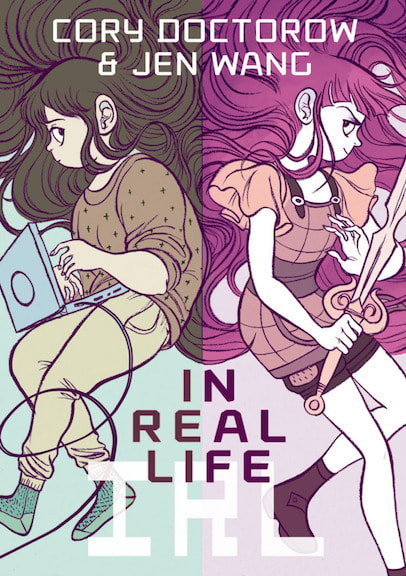
Wang, author of Koko Be Good (2010), co-author, with Cory Doctorow, of In Real Life (2014), and co-founder of the Comic Arts LA festival, will be joined by Doctorow, as well as two other notable comics creators, Molly Knox Ostertag and Tillie Walden.

Doctorow is of course a novelist (author of Little Brother among others), columnist, tech expert and activist, and the co-editor of Boing Boing.

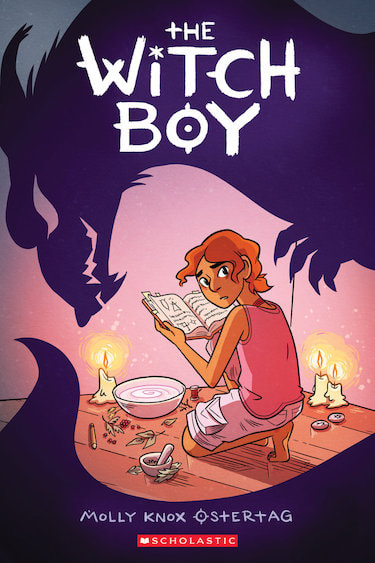
Ostertag is the author of the recent graphic novel The Witch Boy (whose exploration of gender resonates with The Prince and the Dressmaker), co-creator of the graphic novel Shattered Warrior, and co-creator of the ongoing webcomic Strong Female Protagonist.

​
Walden is author of the recent graphic memoir Spinning (one of 2017's most acclaimed comics) and the webcomic (soon to be graphic novel) On a Sunbeam, as well as the graphic books The End of Summer, I Love This Part, and A City Inside.
This is an incredible gathering of talent. Frankly, it would be hard to imagine a stronger panel than this when it comes to the intersection of children's publishing and graphic novels, small-press and independent comics, women comics creators, and explorations of gender and sexuality in comics. I dearly hope to make this event, which I expect is going to be great!
0 Comments
The Prince and the Dressmaker

3/14/2018

0 Comments

 
Picture
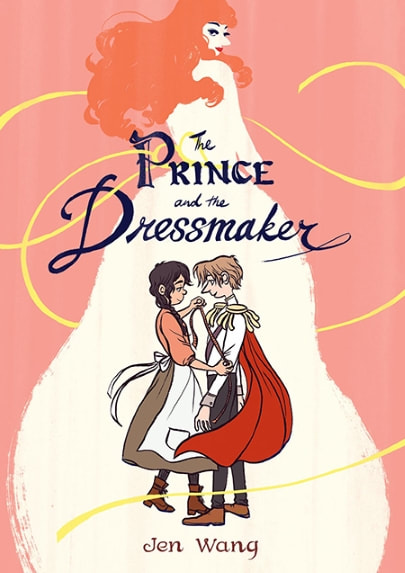
The Prince and the Dressmaker. By Jen Wang. First Second Books, February 2018. ISBN 978-1626723634. $16.99.
(New to KinderComics? Check out our introductory post!)
The Prince and the Dressmaker, Jen Wang’s new graphic novel, is her third, following Koko Be Good (2010) and In Real Life (2014). All her books have been well reviewed and admired, but this one is likely to be remembered as her breakout, deservedly so. A genderbending YA fairy tale romance set in a make-believe Paris on the cusp of modernity—a Belle Époque Paris with haute couture and department stores but no trace of Industrial Age grime—​The Prince and the Dressmaker tells a tender story of nonconformity, the delicate art of public personhood, and desire. I especially like the way it does not editorialize about desire but instead evokes it, often wordlessly, hauntingly—without moralistic signposting and with a florid style that captures the flush of recognition and the confusion of feelings that desire can bring. A marvel of fluid, expressive cartooning, this book takes a fairly shopworn notion, that of the progressive fairy tale (often a go-to genre for feminist, gender-nonconforming subversiveness), and fills it with startling new life. It gives fresh evidence of Wang’s deftness and grace as a comics artist:  her characters live, her rhythms draw this reader breathlessly in, and her pages pop. In short, this is artful work, fraught and emotionally daring, ultimately affirming, and, well, ravishing.
As the above cover hints, The Prince and the Dressmaker is a prince-and-pauper fable about a process of artistic co-creation: the collaboration between a hard-working seamstress and designer, Frances, and a furtively cross-dressing prince, Sebastian, for whom Frances makes dresses. Sebastian endures his parents' attempts to marry him off to this or that young noblewoman but really only comes alive when he can venture into the world incognito, as Lady Crystallia: a fashion plate and the magnet of every elegant young lady's attention. It is Frances's skill and hard work that transform Prince into Lady; essentially, Crystallia is their joint work of art, with Frances as designer and Sebastian as model. Their clandestine partnership grants Sebastian a chance to live more freely, though only for brief, risky episodes, and Frances a chance to practice her art, but only anonymously. It's a match made in Heaven—or isn't, since each can only enjoy the work of creating Lady Crystallia by hiding or disavowing who they are. Sebastian remains closeted, and Frances remains unknown and unsung, denied the opportunity to take her skills public and fashion an autonomous career. The story tugs at this problem, and one other: that of unacknowledged, perhaps confused, desire. That is, The Prince and the Dressmaker is a love story as well as a Künstlerroman. 
Picture
The novel's plot is not especially devious or complex, and stakes out familiar territory. I'm reminded of feminist and queer-positive fairy tale books such as The Paper Bag Princess and King and King; feminist and queer-positive fairy tale comics like Castle Waiting, Princeless and Princess Princess Ever After; and the cross-dressing traditions of shojo manga (here slyly inverted) as well as manga's more recent explorations of transgender experience (notably, Shimura). Further, the faux-European setting, at once antique and yet salted with anachronisms in speech and manner, recalls the vague storybook Europe of Miyazaki. Familiar things, as I said. What Wang has accomplished here, though, does not boil down to a bald set of thematic or genre conventions; she wins on the details, which are myriad and lovely. The story comes across delicately, with expressive body language and telling grace notes of observation, and thankfully without intrusive narration or didactic underscoring. Frances and Sebastian have next to nothing in the way of backstory, but they remain distinct, visually quirky, well realized characters: Frances a mix of self-sufficiency, ambition, self-deprecation, and inquisitive desire (she looks at things very intently, yet sometimes bashfully looks away); Sebastian a dutiful, conflicted son as well as a lady (ostensibly genderfluid rather than trans), at times selfish or too caught up in his own need for safe hiding, at other times frank and courageous. Frances is willing to help Sebastian, and vice versa, because of mingled kindness, affection, and self-interest—and the willingness of each is tested. Both endure moments of terrible emotional exposure, betrayal, and bewilderment. Wang works the familiar turf beautifully.
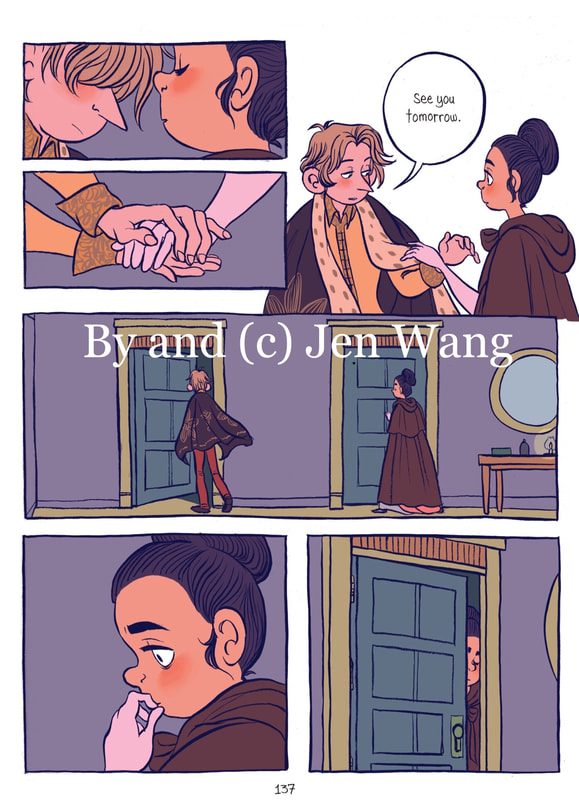
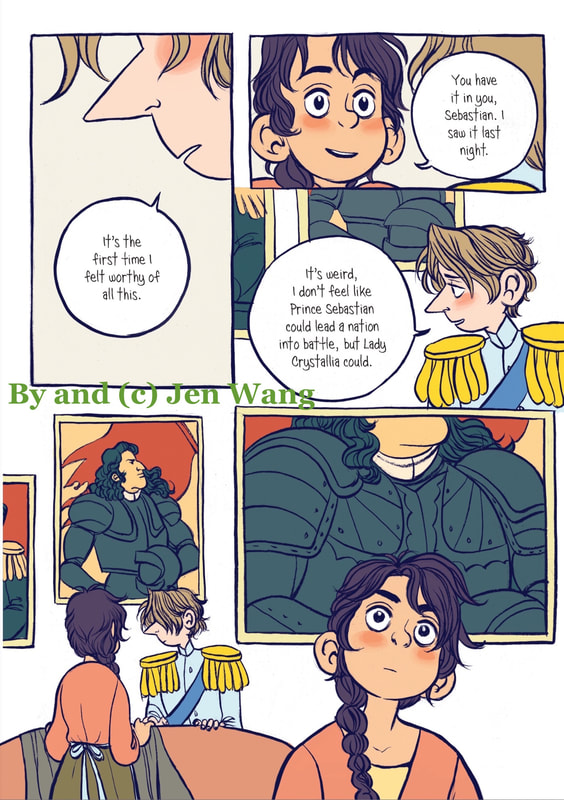
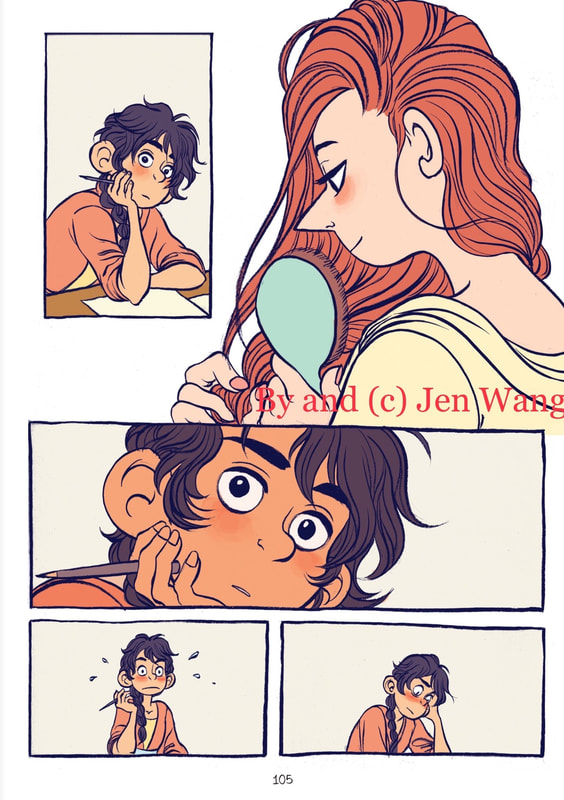
What I like best in The Prince and the Dressmaker is Wang's way with silence. Of the books 250-plus pages, almost a fifth are wholly wordless, and the great majority of spreads in the book include wordless panels or passages. The novel is entirely unnarrated, like a fast-moving film, but the delight Wang so clearly takes in rendering characters—and, my gosh, couture, in great, swooning, rapturous fits—roots the work in the pleasures of drawing and of comics. Some of the wordless passages dilate on brief sequences of action, catching and expanding small moments; others compress time, montage-style, whisking the characters through hours or days with giddy speed. The minimal wording and lavish drawing together convey ambiguous and conflicted emotion beautifully; witness pregnant moments of observation or reflection like this:
Picture
Picture
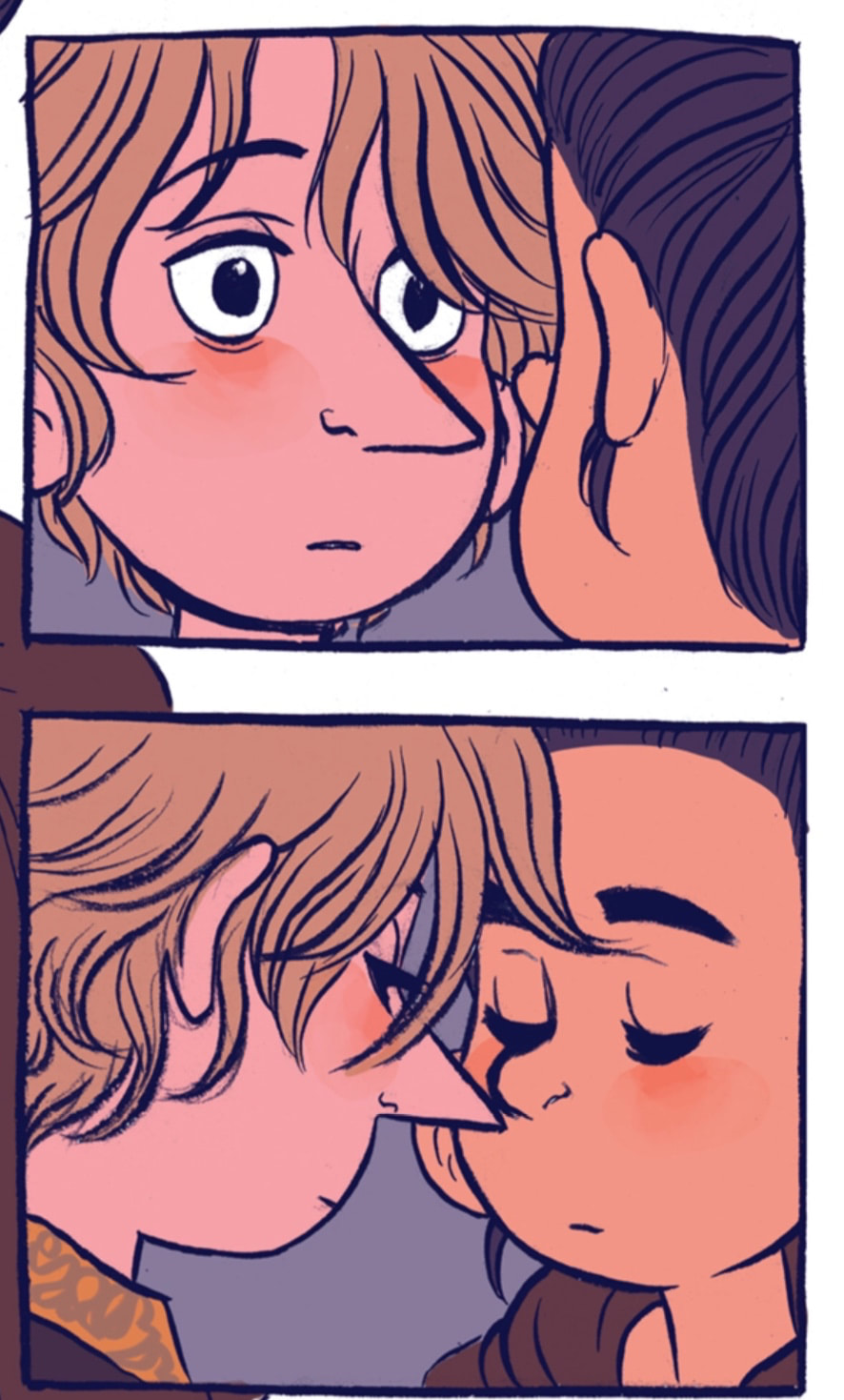
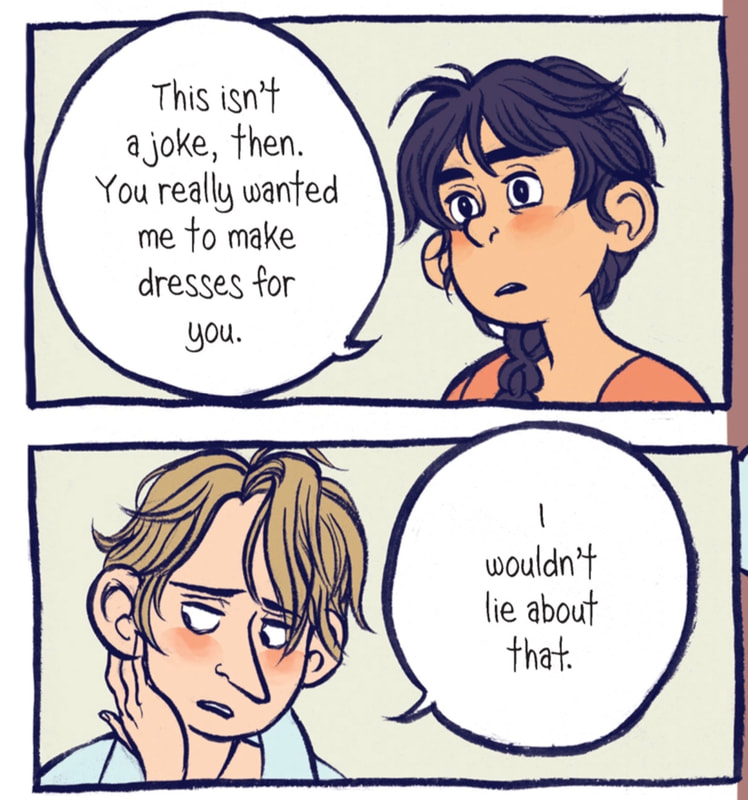
The first example above seems, to me, to flirt with Frances's confusion about her own desires, or perhaps simply with the recognition of Sebastian's androgynous beauty. It says volumes. Both the first and second example show one of the things Wang is so very good at: emotional irresolution and the weight of the unspoken. Throughout the book, pairs of panels will hint at subtle interchanges and abashed feelings:
Picture

Picture
All this happens against the backdrop of gorgeous pages, typically airy and free, generous with open space, against which panels and rows of panels appear to float. Bleeds are common: characters and scenes very often go right to the cut edge of the leaves (and implicitly beyond). Indeed Wang will often highlight a critical pause or loaded moment by placing a character at the bottom edge of the page so that the figure bleeds off, as if to hold the eye momentarily before the page turn. In any case, the pages are consistently dynamic without being attention-begging; Wang has a wonderful layout sense to complement her supple and expressive character drawings. No two pages are the same.
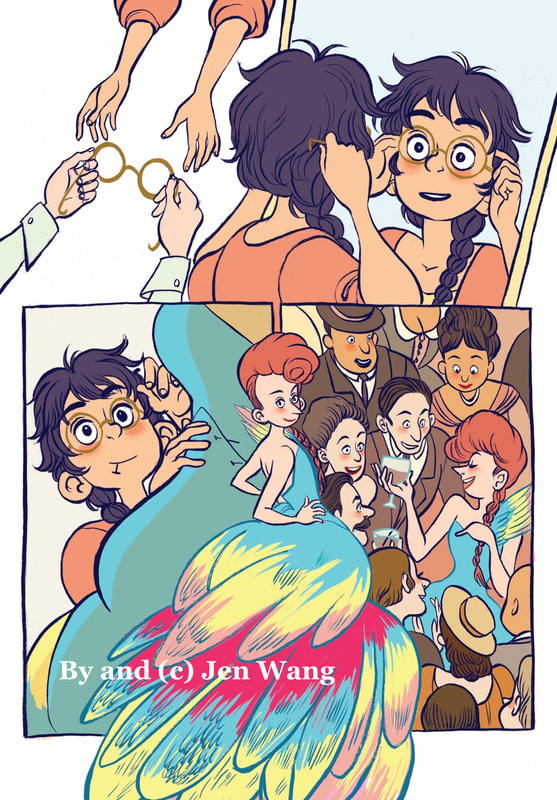
Picture
I could go on about Wang's diverting artistry. It's the sort of thing I love to note: the kinetic freedom of her drawing; the exactness of the movements and expressions captured by her pencil and brush; the ravishing colors; the breath and pulse of the pages. But I think the things that really matter in The Prince and the Dressmaker are the narrative surprises and payoffs (er, these might qualify as spoilers, though I'll try to be vague): the cruelty of Sebastian's eventual exposure; the tender about-face that follows, upending cliched father-son dynamics; the delicious queering of a fashion show that serves as a sort of climax; and the final expression of the unexpressed that is, for me, the book's real climax. Of course all this is expertly cartooned, at the precise point where artistic discipline yields freedom. Yet it's Wang the total storyteller, the writer-artist, who finally gets to me. It's the complete package that made this jaded old reader daub his eyes.
In sum, Wang has hit a new high. The Prince and the Dressmaker is very, very good comics, and puts the fairy tale tradition to wise ends. It envisions a better, braver world, one in which loving self-expression and artistic co-creation happily overleap ideological hurdles, setting more than one spirit free. 
0 Comments
Forward>>

    Author

    See Hatfield, comics and children's culture scholar

    Archives

    September 2025
    June 2025
    May 2025
    January 2025
    December 2024
    July 2024
    June 2024
    May 2024
    March 2024
    June 2023
    February 2023
    December 2022
    July 2022
    April 2022
    January 2022
    December 2021
    September 2021
    August 2021
    June 2021
    May 2021
    January 2021
    December 2020
    November 2020
    October 2020
    August 2020
    July 2020
    June 2020
    March 2020
    February 2020
    January 2020
    December 2019
    November 2019
    October 2019
    August 2019
    July 2019
    March 2019
    December 2018
    November 2018
    October 2018
    July 2018
    June 2018
    May 2018
    April 2018
    March 2018
    February 2018

    Categories

    All
    392
    About KinderComics
    Abrams
    Adaptations
    ALA
    Animal Stories
    Anthologies
    Anti Sexism
    Anti-sexism
    Awards
    Best American Comics
    Bookshops
    BOOM! Studios
    Business
    CALA
    CalRBS
    CBLDF
    CCEL
    Children's Lit In Academia
    Class/Classism
    Collaborations
    Comic Con International
    Comic-Con International
    Comics As Social Protest
    Comic Shops
    Comics In Academia
    Comics Studies Society
    Comic Strips
    Courses
    COVID-19 Lockdown
    DC Comics
    Decade In Review
    Dial Books
    Disability
    Disney/Hyperion
    Drawn & Quarterly
    Early Readers
    Ecology
    EGL Awards
    Eisner Awards
    Essential Graphic Novels
    Ethics
    Eulogies
    Events
    Exhibitions
    Fairy Tales
    Fantagraphics
    Fantasy
    Faves
    First Second Books
    Flying Eye Books
    Folklore
    Food
    French BD
    Friendship
    FSG
    Gallery 13
    Graphic Medicine
    Grief
    Harper
    Historical Fiction
    History
    Holiday House
    House Of Anani Press
    How-to Books
    Immigrants' Stories
    Instructional Books
    International Comic Arts Forum
    Jen Wang
    JLG Selections
    LA Is A Comics Town
    LGBTQIA+
    Libraries
    Lion Forge
    Markets
    Marvel
    McDuffie Awards
    Memoir
    Middle Grade
    Miyazaki
    MLA
    Music
    Mysteries
    Nature
    News
    Nobrow
    Nonfiction
    Oni Press
    Paper Engineering
    Picture Books
    Poetry
    Politics
    Public Speaking
    Race/Racism
    Raina
    Random House
    Reading (and Watching) Hilda
    Reviews
    RH Graphic
    Sales
    Scholarly Works
    Scholastic/Graphix
    Schulz
    SF
    Simon & Schuster
    SOLRAD
    Sports
    Superheroes
    Teaching
    Teaching Roundtable 2018
    Textbooks
    Tillie Walden
    TOON
    TOON Books
    Top Shelf
    Tributes
    Updates
    Webcomics
    Witches
    Year In Review
    Yen Press
    Young Adult

    RSS Feed

Proudly powered by Weebly
  • Blog
  • About
  • Contact
  • Comics@CSUN
  • Comics Studies Society
  • KIRBY!